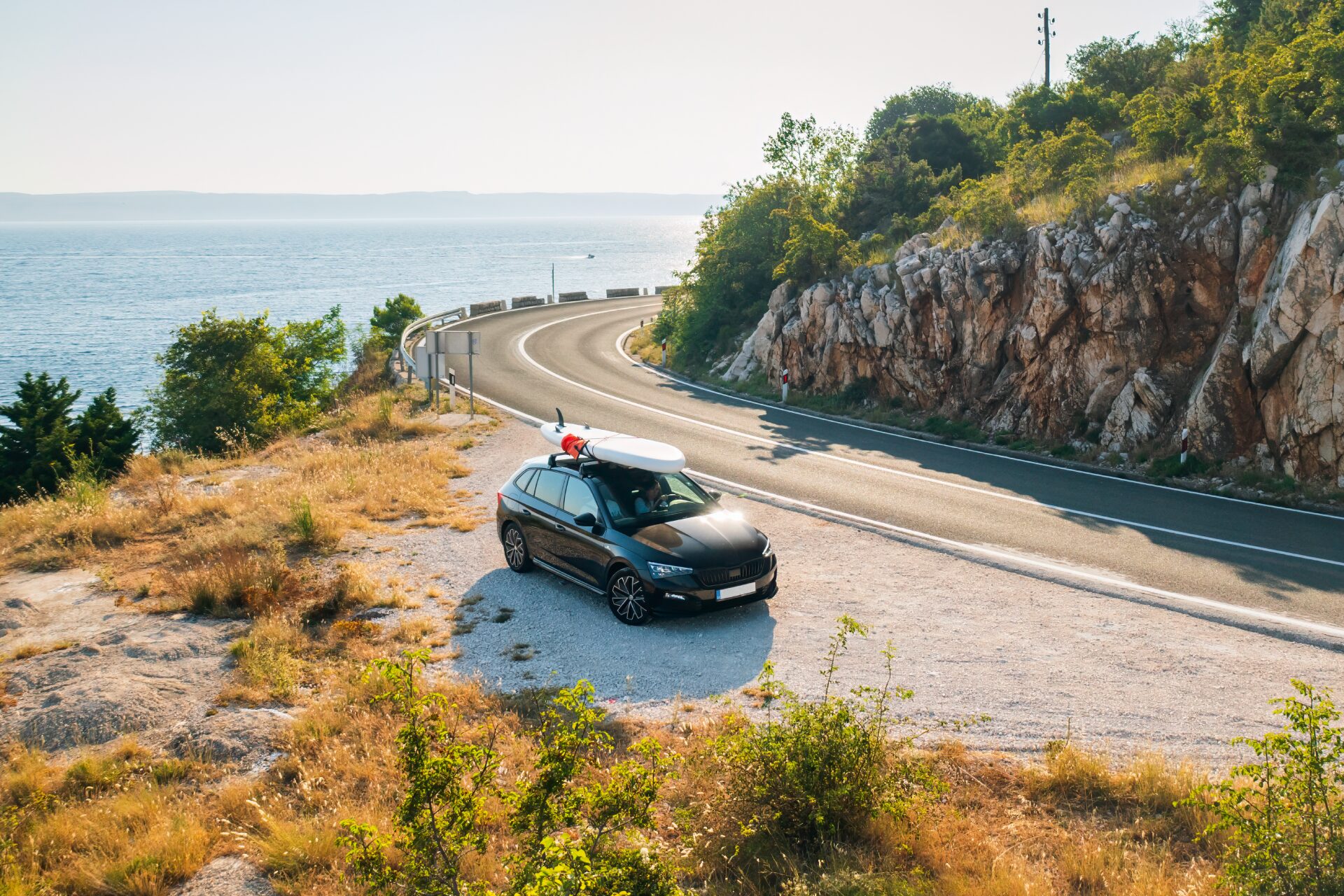
Driving in Crete is how the island reveals its true character, not through the window of a tour bus on a fixed schedule, but at your own pace, on your own terms, down roads that curve through gorges, crest mountain passes, and descend toward coastline so dramatic it stops conversations mid-sentence. Crete is Greece’s largest island, stretching 260 km from the port town of Kissamos in the far west to the palm-fringed shores of Vai in the east, and the vast majority of its most extraordinary experiences are connected not by convenient public transport but by roads that reward the self-driven traveler.
The pink sands of Elafonissi. The abandoned village of Aradena perched above its vertigo-inducing gorge bridge. The mountain taverna with no signpost where lunch is whatever the owner prepared that morning. These are the moments that define a Crete holiday and they all begin with a set of keys and a willingness to explore.
At cretecarsrental.com, we’ve been helping travelers navigate Crete’s roads for years through our Panavia Trust operation, providing well-maintained vehicles, honest advice on routes and conditions, and the kind of local knowledge that only comes from driving this island year-round. This guide covers everything you genuinely need to know about driving in Crete: the road types you’ll encounter, the rules that apply, the mountain passes that thrill, the practical details that matter, and the honest reassurance that Cretan roads are entirely manageable for any reasonably confident driver.
Planning your Crete road trip? Browse Panavia Trust’s fleet collection directly at Chania Airport (CHQ), Heraklion Airport (HER), or delivered to your accommodation.
Why Driving in Crete Is the Best Way to Explore the Island
The question isn’t really whether to drive in Crete. It’s how much you’ll miss if you don’t.
Public transport on the island exists, but it operates within significant limitations. KTEL buses connect the major north-coast towns (Chania, Rethymno, Heraklion, Agios Nikolaos) and run seasonal services to a handful of popular beaches and the Samaria Gorge trailhead. Beyond that, coverage drops sharply. The south coast, where Crete’s wildest beaches and most unspoiled villages are found, is largely unreachable by bus. Mountain communities, remote monasteries, and the hidden coves that experienced travelers consistently cite as trip highlights simply don’t appear on any bus timetable.
Taxis work for short distances but become expensive quickly. Organized tours impose rigid schedules, predetermined lunch stops, and departure times that rarely align with what you’d choose, which is a particular shame on an island where the most rewarding experiences happen when you linger somewhere longer than planned.
Driving in Crete transforms your holiday from a curated selection of accessible highlights into a genuinely open-ended exploration. Pull over when a roadside view demands a photograph. Detour into a village because the church dome caught your eye. Arrive at a beach before the tour buses and stay until the light turns golden. That freedom is precisely what makes the difference between visiting Crete and truly experiencing it. For a complete overview of every destination, route, and hidden corner worth reaching behind the wheel, explore our Things to Do in Crete: The Complete Guide.
Driving in Crete: Road Types You’ll Encounter
Crete’s road network ranges from a modern dual carriageway along the north coast to unpaved mountain tracks that lead to some of Europe’s most spectacular hidden beaches. Understanding the categories helps you plan your routes and choose the right vehicle.
The national highway (BOAK)
Crete’s primary artery runs along the north coast from Kissamos in the west to Sitia in the east. For the majority of its length, particularly the sections between Chania, Rethymno, and Heraklion, it operates as a well-maintained, divided highway with two lanes in each direction. Speed limits reach 90 km/h on the best stretches, and the road surface is comparable to standard European motorway conditions.
East of Heraklion, the highway narrows in sections and becomes more conventional. The stretch between Agios Nikolaos and Sitia involves more winding terrain and single-lane portions, though road improvement projects continue.
What to expect: comfortable, efficient driving that covers distances quickly. Chania to Rethymno is approximately 60 km and takes under an hour. Chania to Heraklion runs roughly 140 km in about two hours.
Provincial and mountain roads
These are the roads that make driving in Crete genuinely memorable. Connecting the north coast highway to mountain villages, south-coast settlements, and inland destinations, they’re typically two-lane paved roads, well-surfaced but narrower, winding, and frequently steep.
Key examples include:
- The descent from Chania to Chora Sfakion through the Askifou Plateau
- The road from the north coast to Elafonissi via the Topolia Gorge
- The approach to the Lasithi Plateau from Heraklion
- The route from Rethymno south to Plakias through the Kourtaliotiko Gorge
These roads demand attention but reward it with extraordinary scenery. Hairpin bends, dramatic gorge views, and mountain villages appear in continuous succession. Drive at a pace appropriate for the road, not the GPS estimated arrival time.
Village roads
Within Cretan villages, roads narrow considerably. Single-lane streets bordered by stone walls, parked vehicles, and the occasional wandering cat are standard. Traffic is minimal but requires patience. Locals navigate these roads slowly and courteously, follow their lead.
Driving in Crete: Rules of the Road
Greek traffic regulations are broadly consistent with standard European norms. Here’s what matters most for visitors:
Speed limits
| Road Type | Speed Limit |
|---|---|
| Built-up areas / villages | 50 km/h |
| Provincial roads outside towns | 90 km/h |
| National highway (BOAK) | 90 km/h (some sections 110 km/h) |
Speed cameras operate on several stretches of the national highway, particularly between Chania and Rethymno and around Heraklion. Fines are issued automatically and can follow you home through your rental agreement.
Seatbelts and child seats
Seatbelts are mandatory for all passengers. Children under 3 must use an appropriate child restraint system. Children aged 3–11 (or under 135 cm) require a booster seat or child seat. If you’re traveling with children, specify child seat requirements when booking your vehicle, at Panavia Trust, we fit seats before your arrival upon request.
Driving license requirements
- EU/EEA licences: Valid EU/EEA driving licences are recognised in Greece and do not normally require an International Driving Permit.
- UK licences: Holders of a valid UK photocard driving licence can drive in Greece without an International Driving Permit. Different rules may apply to older paper licences or licences issued by Jersey, Guernsey or the Isle of Man, so check the current requirements before travelling.
- Non-EU/EEA licences: Requirements vary depending on the country that issued your licence. If you hold a licence from outside the EU/EEA, check whether an International Driving Permit is required or recommended for use in Greece before travelling. Your rental company may also have additional documentation requirements.
- Minimum rental age: There is no single minimum age for every rental company or vehicle category. 21 is common, but some vehicle categories require a higher minimum age, and young-driver fees or minimum licence-holding periods may apply.
Mobile phone usage
Using a handheld mobile phone while driving is illegal in Greece and carries significant fines.
Blood alcohol limit
The legal BAC limit in Greece is 0.50 g/L (0.05%) for most drivers. A lower limit of 0.20 g/L (0.02%) applies to novice drivers and certain other categories. Police carry out frequent roadside breath tests, with particularly intensive and targeted checks during periods of increased traffic and nightlife activity. The safest approach is simple: if you’re driving, don’t drink.
Driving in Crete: Fuel Stations and Refueling
Fuel availability across Crete is generally straightforward, with a few practical considerations:
Station locations
- Fuel stations are plentiful along the north coast highway and in all major towns
- In mountain areas and along the south coast, stations become noticeably sparser, fill up before heading into remote terrain
- Some smaller stations close on Sundays or during the afternoon siesta period (roughly 14:00–17:00)
Fuel types
- Unleaded 95 (Αμόλυβδη), standard for most rental vehicles
- Diesel (Πετρέλαιο κίνησης), verify your vehicle’s fuel type at pickup and pay attention at the pump
- Misfueling is the kind of mistake that ends a day immediately, confirm what your car takes before you leave
Fuel prices
Fuel in Crete can be relatively expensive compared with some parts of mainland Greece. Prices vary by location and market conditions, with petrol prices around or above €2 per litre during parts of 2026. Remote areas and some island locations can be more expensive. Petrol stations display their current prices, so it is worth comparing nearby stations before filling up.
Rental fuel policy
Most rental agreements operate a full-to-full policy: you receive the car with a full tank and return it full. Fill up at a station near the airport on your way back. Don’t wait until the last kilometer, as the closest stations to both Chania and Heraklion airports can have queues during peak changeover times.
Driving in Crete: Parking Essentials
Parking in Crete can range from straightforward to challenging, particularly in the historic centres of the larger towns and at popular beaches during the summer. A little planning makes a significant difference.
Old towns (Chania, Rethymno, Heraklion)
The historic centres of Chania, Rethymno and Heraklion contain pedestrianised streets, restricted-access areas and narrow lanes where driving is inconvenient or, in some locations, prohibited. Rather than trying to drive into the historic core, it is usually easier to park outside or on its edge and continue on foot.
- Use authorised municipal or organised parking areas and follow local signs and access restrictions.
- Parking charges vary considerably by location, city and type of parking, so check the current tariff rather than relying on a fixed hourly price. In Chania, for example, controlled on-street parking currently ranges from €0.20 for 30 minutes to €4.80 for four hours. The city also operates free peripheral Park & Ride facilities with connections to the centre. (chania.gr)
- During July and August, parking near the most popular parts of the old towns can become difficult, particularly later in the day. Arriving earlier generally gives you more options.
- If you are staying in or near an old town, check whether your accommodation has private or designated parking before booking. If it does not, ask the property where guests are normally advised to park.
Rethymno and Heraklion also operate municipal parking and controlled-parking systems, so always follow the local signs and current parking instructions.
Resort areas and beaches
Parking conditions at beaches vary significantly.
- Popular beaches such as Falassarna and Stavros have areas where visitors can park, but facilities and the availability of marked spaces vary by location.
- At the busiest beaches and attractions, parking can become difficult during peak summer hours. Arriving earlier is usually the easiest way to improve your chances of finding a convenient space.
- Roadside parking is common in some resort and beach areas, but it is not automatically permitted. Check signs, markings and the width of the road before leaving your vehicle.
- Never park where you obstruct traffic, block access for emergency vehicles or create a hazard on a narrow approach road.
Villages and rural areas
Parking in many Cretan villages is relatively informal, but that does not mean that you can park anywhere.
If there is a suitable open space or designated parking area, use it. On narrow village roads, leave enough room for other vehicles, including larger local vehicles and emergency services, to pass.
Avoid blocking entrances, driveways, junctions, bends or the access to local businesses. If you are unsure whether a particular space is appropriate, ask locally rather than assuming that an apparently empty area is available for parking.
Practical tip from our team: If you’re staying in or near an old town, check the parking situation before you arrive. Choosing accommodation with private or designated parking or asking your host for the most convenient nearby parking area, can eliminate one of the most common sources of unnecessary stress when driving in Crete.
Driving in Crete: Mountain Roads and Hairpin Bends
Mountain driving is where Crete genuinely distinguishes itself and where first-time visitors tend to experience both their greatest anxiety and their greatest reward. The roads that cross Crete’s mountainous spine deliver landscapes that rank among the most dramatic in all of southern Europe. They also demand respect and attention.
What mountain driving involves
- Hairpin bends: continuous switchbacks are standard on roads descending to the south coast. The Chania–Sfakia road features dozens. They’re well-surfaced but tight.
- Steep gradients: both ascents and descents can be sustained and steep. Use lower gears on downhill stretches to preserve your brakes — this isn’t optional advice, it’s essential practice.
- Narrow sections: occasional single-lane passages where oncoming traffic requires one vehicle to pull aside. The convention is clear: the vehicle with more room to maneuver gives way.
- Sheer drops: guardrails exist on the most exposed sections but not universally. The views are magnificent; keep your eyes on the road and stop at designated viewpoints to appreciate them properly.
- Livestock: goats on the road are a genuine feature of mountain driving in Crete, not a travel-writer cliché. They appear around blind corners and respond to car horns with magnificent indifference. Slow down, wait, and appreciate the authenticity.
The most rewarding mountain drives
| Route | Distance | Drive Time | Character |
|---|---|---|---|
| Chania → Chora Sfakion | 70 km | ~90 min | Hairpin descent through gorge-carved terrain to the Libyan Sea |
| Heraklion → Lasithi Plateau | 50 km | ~75 min | Winding ascent to a high mountain plateau with windmills and caves |
| Rethymno → Plakias (via Kourtaliotiko) | 35 km | ~45 min | Dramatic gorge drive opening onto the south coast |
| Chania → Elafonissi (via Topolia) | 76 km | ~90 min | Mountain hamlets and gorge tunnels leading to pink sand |
| Askifou → Imbros Gorge | 20 km | ~30 min | High plateau drive to one of Crete’s finest hiking trailheads |
For detailed destination ideas along these routes, explore our Things to Do in Crete guide.
Driving in Crete: Unpaved Roads — Where They Go and What to Know
A handful of Crete’s most iconic destinations sit at the end of unpaved tracks. Whether you attempt them depends on your vehicle, your insurance coverage, and your appetite for adventure.
Remote south-coast beaches
Certain beaches along the south coast, particularly west of Chora Sfakion and in the Selino district, require short unpaved approaches. Conditions vary from well-graded gravel to genuinely rough terrain depending on recent weather and maintenance.
Mountain shortcuts
Older mountain tracks connecting villages sometimes appear as shortcuts on mapping apps. Exercise caution: what Google Maps labels as a “road” may be a goat path with aspirations. When in doubt, take the longer paved route.
Insurance and unpaved roads
This is critical: many standard rental agreements exclude coverage for damage sustained on unpaved roads. Before you take any gravel track, verify two things:
- Your rental agreement permits driving on unpaved surfaces
- Your vehicle category is genuinely appropriate for the conditions
At Panavia Trust, we discuss planned routes with renters at booking and advise honestly on which vehicle categories are suitable, because a transparent conversation beforehand prevents expensive surprises afterward. For complete insurance details, see our Car Rental Insurance in Crete guide.
Driving in Crete: Local Driving Culture and Etiquette
Cretan drivers have their own rhythms and conventions, understanding them makes your experience significantly smoother and less stressful.
The shoulder pull-over
On two-lane roads, slower vehicles routinely drift onto the shoulder to allow faster traffic to pass. You’ll see trucks, agricultural vehicles, and unhurried locals do this constantly. You’ll be expected to do the same when someone approaches from behind at a higher speed on mountain roads. It’s not aggressive, it’s cooperative, and it’s the single most important local convention to understand.
The hazard light thank-you
When someone pulls aside to let you pass, a brief flash of your hazard lights serves as the universal Cretan expression of gratitude. It’s used everywhere, by everyone, and skipping it is considered poor form. Adopt this habit immediately.
Overtaking
Overtaking on two-lane roads is common and generally conducted with care. Wait for clear sightlines, use your indicators, and don’t attempt to pass on blind mountain curves, the vehicle approaching from the opposite direction may be a bus.
Honking
Horn usage in Crete is communicative rather than aggressive. A brief tap before a blind corner on a mountain road warns oncoming traffic of your presence. A short beep as you pass through a narrow village alerts pedestrians. Sustained, angry honking is rare and unnecessary.
Pedestrians and village roads
In villages, pedestrians share the road with vehicles as a matter of longstanding habit. Elderly residents crossing the street, children, and people carrying shopping all have an informal but deeply entrenched right of way. Slow down and yield, this is their home, you’re the guest.
General temperament
Cretan drivers are, by southern European standards, notably relaxed outside the cities. Road rage is uncommon. Patience is the default. The aggressive driving reputation that sometimes attaches to Greek driving is far more characteristic of Athens than of Crete’s countryside. Driving in Crete is calmer than most first-time visitors expect.
Driving in Crete: Navigation and GPS Tips
Getting around Crete is straightforward with modern navigation, but a few practical notes will save you time:
Google Maps vs. offline maps
Google Maps works well across Crete and provides accurate driving times for most routes. However:
- Mobile data coverage drops in mountain areas and certain south-coast stretches
- Download offline maps for the entire island before you arrive. Τhis is essential, not optional
- Waze has a smaller user base on Crete and provides less reliable information for rural roads
Road signage
- Major routes are signed in both Greek and Latin script
- Village and secondary road signage can be inconsistent. Οccasionally a sign appears only in Greek, or not at all
- Old road signs sometimes coexist with new ones pointing to the same destination via different routes
Navigating to beaches
Many of Crete’s beaches don’t have formal addresses. Search by beach name in Google Maps, most popular and semi-popular beaches are accurately pinned. For genuinely remote spots, ask locally and follow verbal directions with the map as a backup.
Avoid routing through old towns
Navigation apps occasionally route you through the pedestrianized streets of Chania or Rethymno’s old town. Override these directions and follow the ring roads instead. If your GPS insists you turn into a narrow stone alley, don’t.
Driving in Crete: Seasonal Differences
The character of driving in Crete shifts noticeably across the year:
Peak summer (July–August)
- The national highway carries its heaviest traffic, though genuine congestion is limited to the approaches to Heraklion and Chania
- Beach parking fills early. Αrrive before 10:00 at popular spots
- Mountain roads remain pleasantly uncrowded even in peak season
- Heat can affect alertness on long drives. Carry water, use air conditioning, and take breaks
Shoulder season (May–June, September–October)
- The ideal driving window: warm weather, manageable traffic, lower rental prices
- All roads are open and fully accessible
- Beach parking is significantly easier
- Evening light lasts longer and makes late-afternoon drives particularly rewarding
Winter (November–April)
- The national highway remains open year-round
- Mountain passes can experience temporary closures due to snow, particularly the higher-altitude routes (Omalos, Lasithi Plateau access roads)
- The Samaria Gorge closes for the season, removing the primary reason to drive to Omalos
- South-coast roads are open but can be affected by heavy rainfall
- Traffic is minimal. You may drive for kilometers without encountering another vehicle
- Driving in Crete during winter offers a profoundly different, quieter experience. Atmospheric mountain villages, empty roads, and dramatic skies
Driving in Crete: The Routes Our Renters Love Most
Every route below has been driven by our team and recommended by our renters. Each one demonstrates why driving in Crete consistently ranks as a trip highlight rather than a mere necessity.
Chania to Elafonissi
- Distance: 76 km | Time: approximately 90 minutes
- Through olive groves, the spectacular Topolia Gorge (with its cave church of Agia Sofia), mountain chestnut villages, and finally the descent to Elafonissi’s rose-tinted shores
- Entirely paved, suitable for any vehicle
- The return drive at sunset is equally beautiful
The Sfakia Mountain Drive
- Distance: 70 km from Chania to Chora Sfakion | Time: approximately 90 minutes
- One of the most dramatic drives in all of Greece, ascending to the Askifou Plateau, then descending through endless hairpins with the Libyan Sea materializing below
- Add the detour to Frangokastello for a 14th-century Venetian fortress on a wild beach
- For the complete Sfakia experience, explore our Things to Do in Chania guide
Rethymno to Preveli Beach
- Distance: 35 km | Time: approximately 45 minutes
- South through the Kourtaliotiko Gorge , sheer cliff walls, a river gorge far below, and the sound of wind through the canyon
- Preveli’s palm-fringed beach at the end is an extraordinary reward
- Completely paved, manageable in any vehicle
Heraklion to Matala (via Gortyna and Phaistos)
- Distance: 70 km | Time: approximately 90 minutes
- Combines archaeology (the Roman ruins of Gortyna, the Minoan palace of Phaistos) with one of Crete’s most iconic beaches
- A perfect full-day circuit with multiple stops
- Well-paved throughout
The Full Island Crossing: Chania to Sitia
- Distance: approximately 300 km | Time: 4–5 hours direct, 5–7 days recommended
- The definitive Crete road trip — coastal highway, mountain detours, ancient sites, remote eastern beaches
- Best experienced with overnight stops in Rethymno, Heraklion, and Agios Nikolaos
- One-way rental from Chania Airport to Heraklion Airport (or vice versa) is the ideal format
For beach-focused route ideas, see our Discover the Best Beaches guide.
Driving in Crete: Choosing the Right Vehicle for the Terrain
Your vehicle choice should reflect your planned routes, not just your budget. Crete’s terrain varies dramatically, and the right match makes every drive more comfortable and every destination more accessible.
Economy and compact cars
- Handle all paved roads comfortably (including mountain passes)
- Fuel-efficient and easy to park in towns and villages
- Not suitable for unpaved tracks (remote south-coast approaches etc)
- Ideal for couples, solo travelers, and itineraries focused on accessible destinations
Mid-size vehicles
- More comfort for longer drives and higher-speed highway stretches
- Adequate space for families or groups of 3–4 with luggage
- Still manageable on narrow village roads
- The versatile choice for week-long explorations covering both coasts
SUVs and higher-clearance vehicles
- Essential for certain remote routes
- Greater confidence on rough terrain and steep gravel roads
- Worth the premium if your itinerary includes off-the-beaten-path destinations
- Advisable for winter driving when mountain conditions are less predictable
Automatic vs. manual
Manual transmission dominates the Cretan rental market. If you require an automatic, particularly important for mountain driving if you’re not comfortable with manual on steep gradients, reserve early. Peak-season automatic availability is limited.
Browse Panavia Trust’s complete fleet to match your itinerary to the right vehicle category.
Quick Reference: Vehicle Categories by Road Type
A practical guide for matching your planned routes to the right car:
| Road Type | Suitable Vehicles | Notes |
|---|---|---|
| National highway (BOAK) | All categories | Straightforward, well-maintained dual carriageway |
| Mountain pass roads (paved) | All categories | Compact and above recommended for comfort on sustained climbs |
| Village and narrow roads | All categories | Smaller vehicles easier to maneuver |
| Remote south-coast tracks | SUV / higher-clearance | Verify rental agreement covers gravel roads |
| Winter mountain roads | Mid-size or SUV | Higher clearance advisable; check for seasonal closures |
Driving in Crete: Common Concerns (and Why They Shouldn’t Stop You)
First-time visitors often arrive with anxieties about driving in Crete that prove entirely unfounded once they’re behind the wheel. Here are the most common concerns and the honest reality:
“I’ve heard Greek drivers are aggressive”
Driving in Crete has its own local rhythm, which can initially feel quite different from driving elsewhere in Europe. Outside the busiest urban areas, traffic is generally lighter, but local drivers can be fast and assertive, particularly on the main roads. One important local convention is to move safely towards the right-hand shoulder when a faster vehicle approaches from behind, allowing it to pass. This is common practice, but it should only be done when the shoulder is clear and it is safe to do so.
Don’t assume that every driver will follow the rules or drive at the same pace as you. Drive defensively, maintain a safe speed, and let faster traffic pass when it is safe. Once you understand the local rhythm, driving in Crete becomes much easier to navigate.
“The mountain roads look terrifying”
They look dramatic, because they are dramatic. But they’re also well-maintained, clearly marked, and driven daily by locals in ordinary vehicles, including delivery trucks and school buses. Drive at a comfortable pace, use low gear on descents, and stop at viewpoints. The roads that seem intimidating on YouTube videos are perfectly manageable at real-world speeds.
“I’m not confident driving on the right”
If you’re accustomed to driving on the left (UK, Ireland, Australia, Japan), switching to right-hand driving takes approximately 30 minutes of adjustment on Crete’s quiet roads. Collect your car at the airport, where the initial roads are wide and uncomplicated, and allow yourself a brief acclimatization period before attempting anything challenging.
“What if I break down in a remote area?”
Rental companies provide roadside assistance numbers. Mobile coverage extends across most of the island, with gaps in deep gorges and certain mountain stretches. Carry the assistance number prominently. In our experience, breakdowns with well-maintained vehicles are exceptionally rare, which is precisely why vehicle condition matters when choosing your rental company.
“I don’t know the roads”
Neither does anyone on their first visit. That’s what GPS, offline maps, and a supportive rental company are for. At Panavia Trust, we routinely advise renters on specific routes, road conditions, and vehicle suitability because a five-minute conversation before departure prevents confusion on the road.
Browse Panavia Trust available vehicles! & View all delivery locations!
What Our Renters Tell Us
⭐⭐⭐⭐⭐
“We were genuinely nervous about driving in Crete before we arrived. Μountain roads, unfamiliar country, driving on the right for the first time. Within an hour of collecting our car from Panavia Trust at Chania Airport, all of that anxiety had evaporated. The roads were far better than we expected, the other drivers were patient and polite, and by the second day we were confidently navigating hairpin bends down to Sfakia like we’d been doing it for years. The car was excellent, the advice on routes was spot-on, and we’ve already booked again for next summer.”
— David & Karen P., Bristol, UK
⭐⭐⭐⭐⭐
“Solo female traveler, first time in Crete, first time driving on the right. I can honestly say driving in Crete was the highlight of my entire trip. I went everywhere — the Lasithi Plateau, tiny villages with no tourist facilities, south-coast beaches with nobody else there. The freedom was extraordinary. The car from Panavia Trust was clean, reliable, and exactly what they described. I felt safe the entire time. Can’t recommend it highly enough.”
— Yuki T., Tokyo, Japan
Ready to Drive Crete?
Every lagoon, gorge, mountain village, and hidden beach in this guide becomes dramatically more accessible and infinitely more enjoyable, when you have the right car and the right company behind it.
Browse Panavia Trust’s Fleet Collection directly at Chania Airport (CHQ) or Heraklion Airport (HER) etc. Delivery to your accommodation anywhere on the island. Well-maintained vehicles, transparent pricing, zero hidden charges. View all delivery locations!
The Road Is the Experience
Most travelers treat driving as the gap between destinations, the unavoidable transition from hotel to beach, from town to attraction. In Crete, the drive itself is the attraction. The gorge road to Sfakia delivers views that rival anything at the bottom. The mountain pass to Elafonissi threads through villages where time moves at a different speed. The coastal highway between Rethymno and Chania unfolds one of the Mediterranean’s finest shorelines at a pace you control entirely.
Driving in Crete is not something to endure. It’s something to savor. The roads are better than their reputation suggests, the landscapes they traverse are genuinely world-class, and the freedom they provide is the single greatest upgrade any Crete holiday can receive.
At Panavia Trust, we believe the finest version of a Crete holiday begins the moment you take the wheel. A well-maintained car, transparent pricing, clear insurance, and local knowledge from people who drive these roads every day, that’s what we provide, and that’s what makes the difference between a good trip and an unforgettable one.
Reserve your car now via Panavia Trust! Transparent pricing, genuine local knowledge, and the freedom to explore Crete exactly the way you want.
Frequently Asked Questions About Driving in Crete
Is driving in Crete safe?
Yes, provided you drive carefully and adapt to the road conditions. Crete’s main roads are generally paved and adequately signed, although road quality and signage can vary, particularly away from the main routes. Mountain roads are often winding, narrow and steep, and require extra attention, especially around blind bends and exposed sections.
Local drivers may be more accustomed to the island’s roads and can sometimes travel faster than visitors expect. If a faster vehicle approaches from behind, allow it to pass when it is safe to do so, but never compromise your own safety by moving onto an unsuitable shoulder or stopping in a dangerous position.
You don’t need specialist driving skills to drive in Crete, but defensive driving, sensible speeds and extra caution on mountain roads are essential.
Do I need an international driving permit for Crete?
EU/EEA driving licences that are valid in their country of issue can generally be used in Greece. EU driving licences are recognised throughout the EU, subject to the usual validity requirements.
UK visitors with a valid UK photocard driving licence can drive in Greece without an International Driving Permit (IDP). If you still hold a paper UK licence, or a licence issued by Jersey, Guernsey or the Isle of Man, different requirements may apply, so check the current rules before travelling.
For visitors from outside the EU/EEA and UK, requirements depend on the country that issued the licence. If you are unsure whether your national licence is recognised in Greece, check with the Greek authorities or your embassy before travelling. Rental companies may also have their own documentation requirements.
What side of the road do you drive on in Crete?
Greece drives on the right-hand side of the road, as in most of continental Europe. Most vehicles available for hire in Crete are left-hand-drive.
If you normally drive on the left, allow yourself a little time to adjust, particularly when negotiating roundabouts, junctions and narrow mountain roads. Take your time during the first part of your journey rather than trying to match the pace of local traffic.
Can I drive a normal car everywhere in Crete?
A standard compact or mid-size rental car is suitable for the vast majority of Crete’s paved roads, including the main national highway and many mountain routes.
That does not mean every road is equally easy. Some mountain roads are narrow, steep and winding, and conditions can vary considerably away from the main routes.
The important distinction is between paved roads and unpaved tracks. Some popular destinations involve rough unpaved sections. Rental agreements commonly restrict driving on such roads, and insurance coverage may be excluded unless the rental company has specifically authorised it.
If your itinerary includes gravel or dirt roads, check the rental agreement before booking and confirm that both the vehicle and insurance cover are appropriate. Do not assume that an SUV automatically makes an unpaved route permitted.
How are the mountain roads in Crete?
Crete’s mountain roads can be narrow, winding and steep, with frequent hairpin bends and sections where visibility is limited. Some exposed roads have guardrails, but protection is not continuous on every route.
Drive at a speed that allows you to stop within the distance you can see, particularly before blind bends. On long descents, selecting a lower gear can reduce reliance on the brakes.
If a faster vehicle approaches from behind, allow it to pass when there is a safe opportunity. Do not move onto an unsuitable shoulder or stop in a dangerous position simply to let another vehicle through.
The scenery can be spectacular, but only stop where it is safe and permitted to do so.
Is there much traffic in Crete?
Traffic varies considerably by location and season.
The busiest conditions are generally found around the main urban areas, particularly Heraklion and Chania, and on the northern road network during the summer season. Delays are possible around cities, junctions and popular tourist destinations.
Away from the main routes, traffic can be considerably lighter, particularly on quieter mountain and rural roads. However, popular attractions can still become busy during peak season, so it is better not to assume that every mountain or south-coast route will be empty.
For a more relaxed driving experience, travelling outside the busiest summer periods can help. May–June and September–October generally offer less tourist traffic than July and August, although conditions vary by destination and day.
Where can I park in Chania and Heraklion?
The historic centres of Chania and Heraklion contain extensive pedestrianised or restricted-access areas. Rather than attempting to drive into the historic cores, it is generally easier to leave your car in an authorised parking area and continue on foot.
In Chania, the municipality operates controlled on-street parking as well as organised and peripheral parking options. The current controlled-parking tariff ranges from €0.20 for 30 minutes to €4.80 for four hours, with a four-hour maximum in the controlled zones. The municipality also operates free Park & Ride facilities at designated peripheral locations.
In Heraklion, organised parking is available in several locations. For example, the Heraklion Port Authority currently lists parking areas charging €3–€3.50 for the first three hours, with additional hourly and daily charges depending on the car park.
Parking rules and prices can change, so check the signs and the relevant municipal or parking-operator information when you arrive. During the busiest summer periods, arriving earlier can make finding a convenient space considerably easier.
What happens if I break down?
Your rental company should provide a roadside-assistance contact number with the vehicle or rental documentation. Keep the number saved on your phone before setting off.
Mobile-phone coverage is available across much of Crete, but reception can be weaker or unavailable in some remote mountain areas and deep gorges. If you are travelling into a particularly remote area, it is sensible to have your route and essential contact details available offline.
A properly maintained rental vehicle reduces the risk of mechanical problems, but no vehicle is completely immune to breakdowns. If a problem occurs, move to a safe location where possible, switch on your hazard lights and contact the rental company’s roadside-assistance service.
If you are renting from Panavia Trust, check the company’s current roadside-assistance arrangements and emergency contact details at the time of booking.
Can I drive from Chania to Heraklion in one day?
Yes. Chania and Heraklion are connected by the main northern road network, and the distance between the two cities is approximately 140 km. The route can be driven comfortably in a single day, with the actual journey time depending on traffic, road conditions and stops.
If your priority is simply getting from one city to the other, allow roughly two hours for the direct journey under normal conditions, while allowing additional time for traffic and breaks.
If you have several days available, however, it can be more rewarding to turn the journey into part of your itinerary and explore places along the way, such as Rethymno and other towns, villages and viewpoints.
A one-way rental can also be convenient if your itinerary begins in Chania and ends in Heraklion, or vice versa, provided the rental company offers the service and the applicable one-way fee is acceptable.
Is driving in Crete difficult for first-time visitors?
For most visitors with normal driving experience, driving in Crete is manageable, but it is not identical to driving in a large, well-planned European city.
The main roads are generally straightforward, while rural and mountain roads can be considerably more demanding. You may encounter narrow lanes, hairpin bends, steep gradients, limited visibility, animals near or on the road, and local drivers who are more familiar with these conditions than you are.
The best approach is to drive defensively rather than trying to match the speed of local traffic. Keep a comfortable speed, leave plenty of space, take extra care on mountain roads and allow faster traffic to pass when it can be done safely.
GPS navigation makes getting around much easier, but downloading offline maps is still a good idea, particularly if you plan to explore remote parts of the island.
You do not need specialist driving skills to explore Crete, but patience, attention and sensible speed are essential, especially away from the main roads.