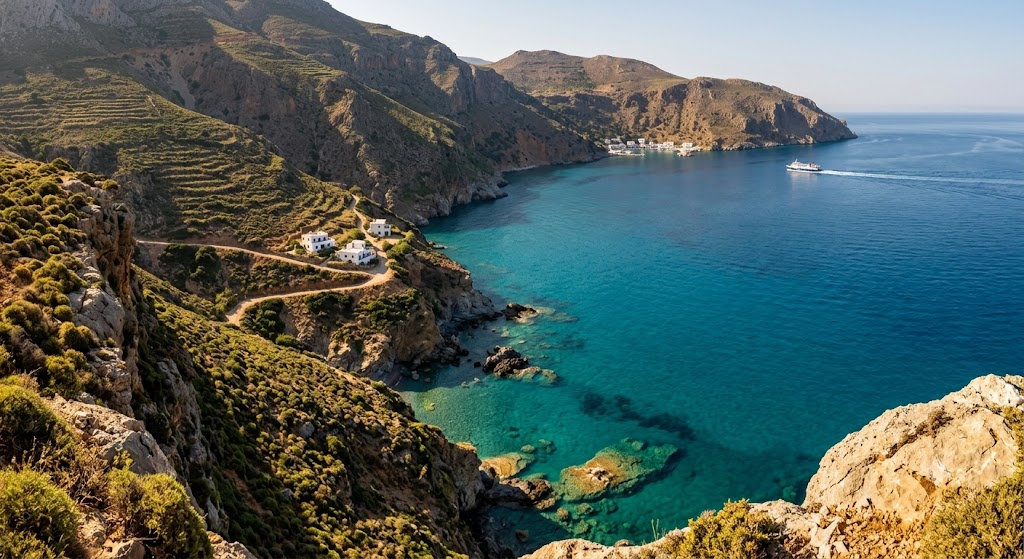
Crete is not an island you can rush. At 260 kilometres long and with four mountain ranges, more than 1,000 kilometres of coastline, a civilisation that predates ancient Greece by 1,500 years, and some of the most diverse natural landscapes in the Mediterranean, it demands a different kind of planning than almost any other Greek destination. Most visitors arrive with a resort booking, a list of famous beaches, and an ambitious plan they’ll inevitably compress into three or four days. This guide exists to give you a more honest picture: what is actually worth your time, what the experience genuinely involves, what competitors’ articles consistently get wrong, and what independent transport makes possible that public buses simply don’t. Whether you have five days or two weeks, whether you’re bringing children or hiking alone, whether you care more about Minoan palaces than palm-lined lagoons, this page covers all of it, practically and without filler.
Crete at a Glance
| Fact | Detail |
|---|---|
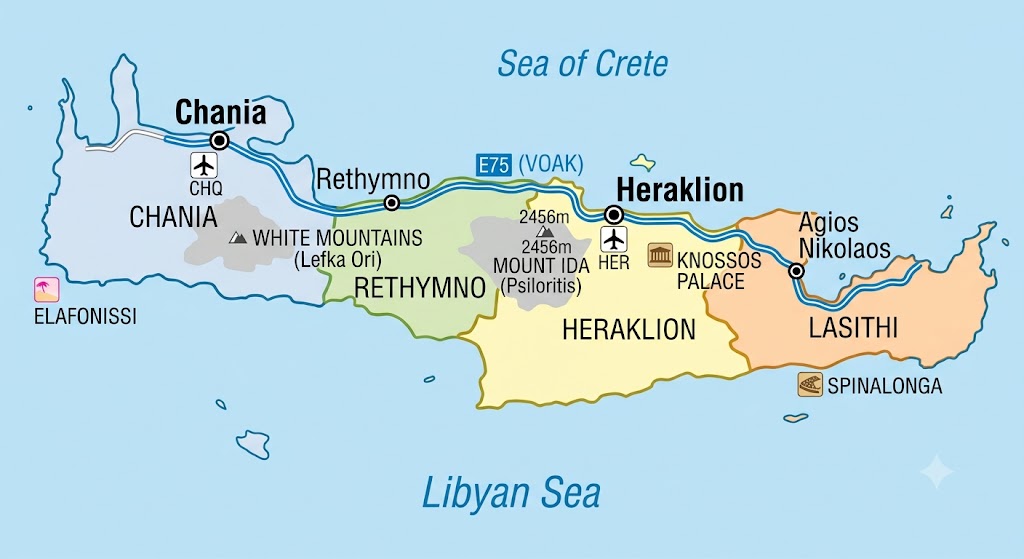
| Size | 8,336 km² — fifth largest island in the Mediterranean |
| Length | 260 km east to west |
| Coastline | Approximately 1,040 km |
| Prefectures | 4 — Chania, Rethymno, Heraklion, Lasithi |
| Main Airports | Heraklion (HER), Chania (CHQ) |
| Highest Peak | Mount Ida (Psiloritis) — 2,456 m |
| Best Months | April–June and September–October |
| Peak Season | July–August (very crowded at popular sites) |
| Currency | Euro (€) |
| Language | Greek (English widely spoken in tourist areas) |
| Driving Side | Right-hand traffic |
| Time Zone | EET (UTC+2) / EEST (UTC+3) in summer |
What’s in This Guide
- Understanding Crete Before You Explore
- The Best Beaches in Crete
- Archaeological Sites and Minoan History
- Gorges and Hiking
- Historic Towns and City Centres
- Monasteries, Castles and Venetian Heritage
- Mountain Villages and Remote Landscapes
- Cretan Food, Wine and Local Experiences
- Sea Activities and Boat Trips
- Nature, Wildlife and Outdoor Adventures
- Suggested Itineraries
- Seasonal Guide: When to Do What
- Practical Planning Tips
- Frequently Asked Questions
Understanding Crete Before You Explore
The most consistent mistake visitors make in Crete is misjudging its size. The north-coast highway (E75) runs most of the island’s length, but many of the best destinations require turning off it and driving into terrain where 50 kilometres can take 90 minutes. The island that looks manageable on a resort map is genuinely large that driving from Kissamos in the west to Zakros in the east takes over four hours without stops.
Understanding this before you plan changes everything. It affects your base, your itinerary length, your vehicle choice, and which experiences you realistically have time for. The four prefectures function almost like distinct islands, each with its own landscape identity, cultural character, and set of things to do.
The Four Regions of Crete
| Region | Capital | Character | Best Known For | Best Base For |
|---|---|---|---|---|
| Chania Prefecture | Chania | Romantic, scenic, rugged west | Elafonissi, Balos, Samaria Gorge, Venetian Old Town | Couples, beach lovers, hikers, photographers |
| Rethymno Prefecture | Rethymno | Historical, central, well-balanced | Venetian Fortezza, Arkadi Monastery, Preveli Beach | First-timers, families, history enthusiasts |
| Heraklion Prefecture | Heraklion | Urban, archaeological, culturally rich | Knossos, Archaeological Museum, Matala, wine country | Culture travellers, wine tourists, mixed groups |
| Lasithi Prefecture | Agios Nikolaos | Quiet, authentic, remote east | Spinalonga, Vai, Zakros, Lassithi Plateau, Elounda | Returning visitors, explorers, nature lovers |
Why Independent Transport Defines the Quality of Your Experience
Crete has a functional public bus network (KTEL) along the north coast corridor between the four main cities. Beyond that corridor, it becomes sparse, infrequent, or completely absent. The beaches, gorges, mountain villages, and remote archaeological sites that most travellers put at the top of their lists (Balos, Elafonissi, the Lassithi Plateau, Preveli, Agios Pavlos, the Amari Valley, the far east coast) are either completely inaccessible by public bus or require hour-long waits, multiple connections, and time constraints that render them impractical.
Organised excursion coaches fill some of the gap, but at the cost of fixed timing, large groups, and no ability to pause where the landscape demands it, stay when you want to stay, or adjust plans based on what you discover. In Crete, a rental car is not a convenience. It is what separates a real exploration of the island from a heavily edited version of it.
Planning Tip: Consider Two Bases Instead of One
For trips of seven days or more, splitting accommodation between two bases, typically Chania or nearby in the west for days 1–4, and Heraklion, Agios Nikolaos, or Elounda in the east for days 5–7, eliminates the long daily driving that comes from trying to cover the island end-to-end from a single location. With a rental car, moving between bases takes 2–3 hours on the E75. Without one, the logistics become prohibitive.
Panavia Trust Delivers Your Car Wherever You Start
Whether you’re landing at Heraklion Airport, Chania Airport, or heading straight to your hotel in Rethymno or Agios Nikolaos, Panavia Trust brings the car to you. No rental office. No airport transfer first. You collect your vehicle at the point you actually need it and start exploring immediately.
For two-base itineraries, one-way rentals are available, pick up in Chania, drop off in Heraklion, or the reverse.
Browse Panavia Trust Vehicles and See All Delivery Locations!
The Best Beaches in Crete – Best things to do in Crete
Crete has over 1,000 kilometres of coastline and several hundred recognised beaches. Most travel articles list the same ten and leave you with no useful way to choose between them. The practical distinctions, crowd levels, accessibility, suitability for children, what the road is actually like, when to visit for the best experience, are rarely addressed. They’re addressed here.
West Crete Beaches (Chania Prefecture)
Elafonissi
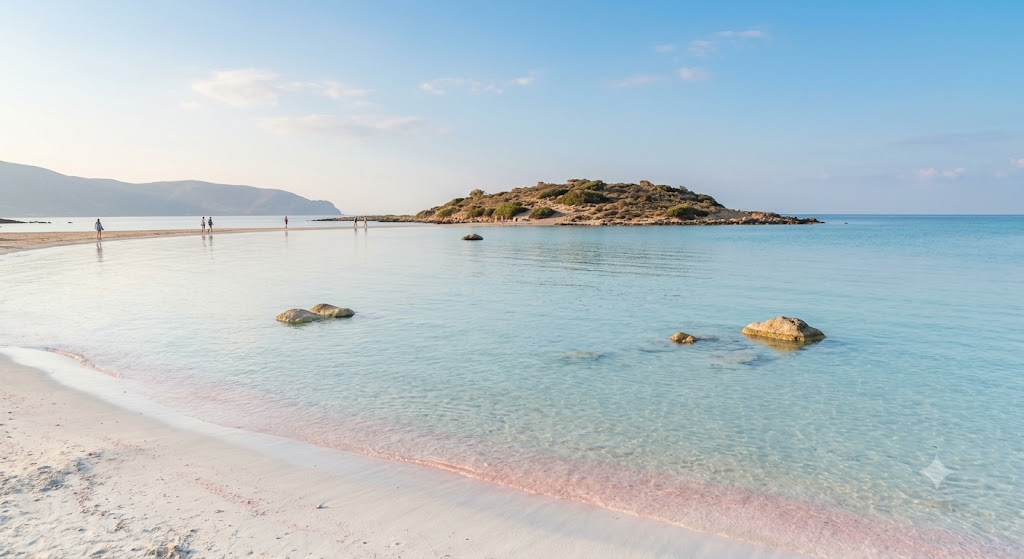
Elafonissi is the most-photographed beach in Crete and, on a quiet morning outside peak season, earns its reputation. The shallow lagoon between the shore and the small adjacent island creates water so calm and warm it suits children as young as toddlers. The sand carries a faint pink hue from crushed coral, more visible at the island end than near the main beach, and less dramatic than photographs suggest under overcast light.
The honest picture in July and August: 3,000 to 5,000 visitors per day. The car park fills by 9am. A queue forms for parking before that. The beach is genuinely crowded by 10am, and the 73-kilometre drive from Chania moves slowly as traffic builds after 9am. In peak season, arrive before 8:30am or accept the conditions.
Outside July and August, Elafonissi is an entirely different experience. In May or early October, the beach holds a fraction of those numbers, the road is clear, and the water temperature is between 20°C and 23°C, comfortable for swimming. The access road passes through countryside that is worth the drive independently of the beach.
Elafonissi: Essential Facts
| Detail | Information |
|---|---|
| Distance from Chania | 73 km / 75–90 minutes (longer in summer traffic) |
| Road Condition | Fully paved — standard car sufficient |
| Parking | Large car park; fee applies in summer; fills early |
| Facilities | Sun loungers, umbrellas, tavernas, toilets, water sports |
| Water Depth | Very shallow — excellent for young children |
| Best Season | May–June and September–October |
| Peak Season Strategy | Arrive before 8:30am or after 5pm |
| Snorkelling | Limited — sandy, shallow bottom |
Balos Lagoon
One of the best things to do in Crete is to visit Balos. It is arguably the most dramatic coastal landscape in Greece. The triangular lagoon forms between three landmasses, the Gramvousa peninsula, the Imeri Gramvousa islet with its Venetian castle, and the mainland cliffs, producing a scene of turquoise water, white sand, and pale limestone that looks improbable even in person.
Balos sits at the tip of the Gramvousa peninsula, largely cut off from the road network. The way in is by boat from Kissamos port, and the journey itself is part of the appeal: the route traces the western coast of the peninsula beneath sheer limestone cliffs and along stretches of shoreline that are entirely inaccessible by land. A genuine cruise through some of the most striking coastal scenery in Crete. Departures are typically at 10 am and 11 am, returning by late afternoon. The excursion includes a stop at Imeri Gramvousa, where a short climb leads to the Venetian castle and panoramic views across the sea, a worthwhile visit in its own right.
Local Insight: Timing the Visit
The lagoon’s colours are at their most vivid around midday, when overhead sun lights up the shallow water to an almost improbable turquoise. If you take the earlier departure you arrive with the best light and have more time to swim, wade the sandbar, and explore before the return sailing.
Falasarna
Falasarna is one of the longest natural sandy beaches on the island. Wide, backed by low dunes, and significantly less crowded than Elafonissi despite being only 35 kilometres further north along the same coast. It faces due west, which produces some of the best sunset light on the island. The ancient Cretan city of the same name lies immediately adjacent, with a visible ancient harbour now standing several hundred metres from the sea. One of the most evident examples of tectonic uplift in the eastern Mediterranean, and genuinely interesting for visitors who pause at it rather than walking straight past.
Seitan Limania
Seitan Limania is a narrow turquoise cove cut into cliffs near the Akrotiri peninsula. The photographs are spectacular. The experience in person is dramatic and genuinely beautiful. It is also one of the more dangerous beach access points in Crete for visitors who underestimate it.
The path from the car park is steep, loose in sections, and requires the use of both hands on the steepest part. The cove has no shade, no facilities, limited rescue access, and a path that becomes significantly more hazardous after rainfall or in high winds. It is not appropriate for children, elderly visitors, anyone with mobility concerns, or visitors wearing anything other than proper footwear. The view from the cliff above the cove, which requires no dangerous descent, is itself worth the drive.
Safety Note: Seitan Limania
Incidents here are not rare. Do not attempt the descent in sandals or smooth-soled shoes. Do not visit after rain, in strong winds, or alone. If you reach the point where the path becomes a narrow exposed ledge and feel uncertain, turn back. The beach is genuinely beautiful. It is not worth an injury or worse.
South Crete Beaches – Best things to do in Crete
Preveli Beach
Preveli sits at the mouth of the Kourtaliotiko Gorge, where a small river meets the sea through a palm-lined delta before a south-facing sandy beach. The combination (palms, river, gorge walls, and sea) is unique in Crete. The beach is accessible by path from the upper car park (approximately 20 minutes, partly stepped and uneven) or by boat from Plakias or Agia Galini during summer. The river itself is swimmable in the lower stretch and noticeably cooler than the sea, a popular sequence is to swim in the sea, then wade upstream through the river shallows into the gorge entrance. Footwear for the rocky riverbed is useful.
Matala
Matala’s beaches are pleasant without being extraordinary. What makes the destination worth knowing is its cultural history. In the late 1960s and early 1970s, the Roman-era cliff caves surrounding the bay became an informal commune for travelling Europeans, Joni Mitchell spent time here, Cat Stevens is said to have visited, and a generation of travellers passed through. The caves are now a paid archaeological site, closed for overnight occupation, but the town retains a mild counterculture atmosphere unlike most Cretan coastal resorts. Combined with the nearby Palace of Phaistos and ancient Gortyn, Matala makes the anchor point of a productive south Crete day trip.
Learn more about this hidden Gem of Crete ”Explore Matala”!
Agios Pavlos
One of south Crete’s most genuinely undervisited beaches. Agios Pavlos sits below a sandstone headland on the Agios Vassilios coast, framed by unusual dune formations and accessible via a mountain road from Spili that passes through some of the most dramatic inland scenery on the island. The water is clear and deep, with excellent swimming. Facilities are minimal. A single small taverna. The drive from Rethymno takes approximately 50 minutes and the landscape en route justifies the journey independently of the beach.
East Crete Beaches
Vai
Vai holds the largest natural palm forest in Europe, a grove of Cretan date palms (Phoenix theophrasti) growing directly behind the beach. The species is endemic to Crete and a handful of other eastern Mediterranean sites. It predates any human cultivation here and is believed to have established naturally from seeds carried by migratory birds. The beach itself is well-organised and busy in summer. Visit before 10am or after 4pm. The palm grove, not the beach, is the reason to come.
Xerokampos
If east Crete has a destination that rewards the effort of reaching it, Xerokampos is it. A sparse settlement of summer houses and a handful of tavernas sits behind three separate small coves with excellent swimming and almost no commercial infrastructure. The road from Zakros village involves a steep descent that is partly unpaved but passable for most vehicles driven carefully. Combined with a visit to the nearby Palace of Zakros and a walk of the Dead’s Gorge, it makes an exceptional full day for visitors willing to drive the 2.5 hours from Heraklion or 3.5 hours from Chania to reach the far east.
Beach Comparison: At a Glance
| Beach | Region | Summer Crowds | Road Access | Facilities | Best For | Drive from Chania |
|---|---|---|---|---|---|---|
| Elafonissi | West | Very High | Paved (standard car) | Full | Families, first-timers | ~80 min |
| Balos | West | High | Rough track (slow drive) | Minimal on beach | Couples, photographers | ~75 min |
| Falasarna | West | Moderate | Paved (standard car) | Good | Sunsets, relaxed swimming | ~55 min |
| Seitan Limania | Akrotiri | Moderate | Paved to car park | None | Experienced scramblers only | ~30 min |
| Stavros | Akrotiri | Moderate | Paved (easy) | Good | Families, calm water | ~25 min |
| Preveli | South | Moderate | Paved to car park | Limited | Nature lovers, couples | ~80 min |
| Matala | South | Moderate–High | Paved (standard car) | Full resort | History interest, culture | ~90 min |
| Agios Pavlos | South | Low | Paved but winding | Minimal | Solitude, scenery | ~85 min |
| Vai | Far East | High | Paved (standard car) | Full | Palm forest, nature | ~3 hr 30 min |
| Xerokampos | Far East | Very Low | Partly unpaved (slow) | Minimal | Explorers, remoteness | ~3 hr 45 min |
The Best Beaches in Crete Are Not on a Bus Route
Of the ten beaches in the table above, only a handful have any public transport access and even those run infrequently with schedules that don’t match the early-morning arrival that makes popular beaches enjoyable.
- Elafonissi: 73 km from Chania. Arrive before 8:30am with your own car and the beach is a different experience
- Balos: rough track access. Time your arrival and departure around the boat crowds only possible with a car
- Falasarna, Agios Pavlos, Xerokampos: no scheduled service at all
With a vehicle from Panavia Trust Car rental, you leave when you decide, arrive before the crowds, and stay until the afternoon light is right. That flexibility is what makes the difference.
Expert Tip: The Peak Season Beach Strategy
Every popular beach in Crete in July and August follows the same pattern: car parks fill between 9am and 10am and begin emptying around 5pm. Visitors with a rental car have the flexibility to arrive before 8:30am (when parking is free, roads are clear, and beaches are genuinely enjoyable) and leave by noon, returning in the late afternoon when the light is better, the crowds are thinner, and the temperature has dropped. Package tourists on excursion buses don’t have this option. It is one of the most practical advantages of independent travel in Crete.
Learn more about Crete’s Hidden Gems!
Archaeological Sites and Minoan History – Best things to do in Crete
Crete’s archaeological significance is difficult to overstate. The Minoan civilisation, Europe’s first advanced civilisation, flourished here between roughly 2700 BCE and 1450 BCE, predating classical Greece by more than a thousand years. The Minoans had writing systems (Linear A, still undeciphered, and its successor Linear B), multi-storey palace architecture, sophisticated plumbing, international trade networks, and an art tradition of extraordinary quality. Four major palace sites survive on the island, plus dozens of smaller sites and cemeteries that span a period from the Neolithic to the Byzantine.
For most visitors, the archaeology of Crete is the most intellectually rewarding part of the island and the most consistently underused, because visiting without basic context produces a confusing experience. Twenty minutes of reading before arrival transforms the same ruins into something completely different.
The Palace of Knossos
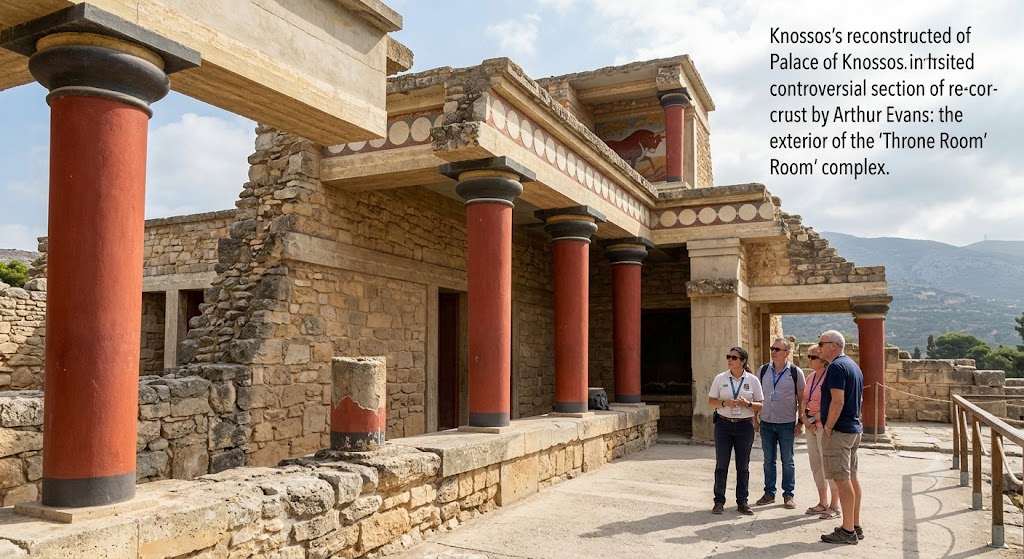
One of the best things to do in Crete is to visit Knossos. It is the most visited archaeological site in Greece after the Acropolis. Excavated by the British archaeologist Arthur Evans from 1900 onwards and controversially reconstructed using reinforced concrete and painted decoration based on Evans’s interpretation of the archaeological evidence, it remains a point of scholarly debate. Evans’s reconstruction is considered by some archaeologists as essential for public understanding; by others as a significant distortion of what was actually found. Both views have merit.
What the debate doesn’t change: Knossos is genuinely impressive, and the visit makes substantially more sense if you’ve read even a brief introduction to Minoan civilisation beforehand. Without it, you’re looking at concrete pillars and faded frescoes. With it, you’re standing in what was once a palace of perhaps 1,300 rooms, the administrative and religious centre of a civilisation that controlled trade routes across the eastern Mediterranean. The Throne Room, containing what may be the oldest throne still in its original position in Europe, is the site’s most affecting space.
Planning Tip: Getting the Most from Knossos
- Arrive at 8am when the site opens by 10am in summer it is genuinely overcrowded
- Allocate 2 hours, additional time adds diminishing returns unless you have a specialist guide
- Hire an official licensed guide at the entrance if you want contextual depth; they make a substantial difference to comprehension
- Visit the Heraklion Archaeological Museum either before or after, it holds the major finds from Knossos (frescoes, artefacts, Linear A and B tablets) and the combination is far more rewarding than either alone
- The site has minimal shade. A hat, water, and sunscreen are non-negotiable in summer
- Knossos is 5 km south of Heraklion city centre and accessible by local city bus as well as car
- Online ticket booking in summer avoids the queue and is available via the official Greek government culture portal
Heraklion Archaeological Museum
Frequently listed as one of the most significant archaeological museums in Europe, the Heraklion Archaeological Museum holds the world’s largest collection of Minoan art and artefacts. The Phaistos Disc, a circular clay tablet bearing an undeciphered script is here. The Bull-Leaping Fresco from Knossos is here. The Snake Goddess figurines, the Harvester Vase, the gold signet rings from Minoan graves, all here. If you visit Knossos without this museum, you have seen the bones and missed the life.
Budget a minimum of two hours. The permanent collection occupies two floors and is organised chronologically from the Neolithic through to the Roman period. Audio guides are available for hire and are genuinely worth taking. The museum is fully air-conditioned (a practical consideration in summer) and the gift shop carries a better range of scholarly publications on Minoan civilisation than almost anywhere else.
The Palace of Phaistos
Phaistos is the second largest Minoan palace in Crete and, for many archaeologists, the more interesting precisely because it was not reconstructed. What you see here is actual ancient material: two-storey staircases built by Minoans 4,000 years ago, storage magazines still containing their original storage jars (pithoi), and a theatrical area that gives a genuine sense of palace-scale Minoan architecture without Evans’s controversial concrete interpretations. The site sits on a commanding hilltop in the Messara plain with panoramic views to Mount Ida. The drive from Heraklion takes approximately 60 minutes.
Gortyn
Gortyn served as the Roman capital of Crete and Cyrenaica (modern Libya) and contains one of the most remarkable open-air exhibits in the Mediterranean: the Law Code of Gortyn, carved in boustrophedon (alternating directional script) on stone blocks dating to approximately 450 BCE. It is the earliest and most complete example of Greek law yet discovered, and it sits outdoors, incorporated into the wall of a Roman odeon, effectively unguarded. You can stand directly in front of it. The wider site is large, partly unexcavated, and almost completely uncrowded. Combined with Phaistos and Matala, it forms a logical south Crete day circuit from Heraklion.
Palace of Zakros
The fourth and easternmost major Minoan palace is the least visited of the group and arguably the most atmospheric. Set in a natural gorge near the small east coast village of Kato Zakros, it was excavated in the 1960s by Nikolaos Platon and found largely undisturbed. Many artefacts were still in their original positions. The beach at Kato Zakros is immediately adjacent to the excavation site. The combination of swimming, Minoan archaeology, and the gorge walk upstream (the Dead’s Gorge) in a completely uncommercialised setting is outstanding for visitors willing to drive the 2 hours 20 minutes from Heraklion.
Archaeological Sites Comparison
| Site | Period | Location | Time Required | Crowd Level | Estimated Entry Fee | Best For |
|---|---|---|---|---|---|---|
| Knossos | Minoan (reconstructed) | 5 km south of Heraklion | 2 hours | Very High | €15 | Visual impact, first-timers |
| Heraklion Museum | Neolithic to Roman | Central Heraklion | 2–3 hours | Moderate | €15 | Artefacts, cultural depth |
| Phaistos | Minoan (original) | 62 km SW of Heraklion | 1.5–2 hours | Low | €8 | Authentic archaeology, atmosphere |
| Gortyn | Minoan to Roman | 46 km south of Heraklion | 1–1.5 hours | Very Low | €8 | Roman history, Law Code |
| Zakros | Minoan (original) | Far east, near Sitia | 1.5 hours + gorge walk | Very Low | €8 | Remote exploration, gorge |
| Aptera | Minoan to Byzantine | 14 km east of Chania | 1–1.5 hours | Very Low | €6 | Multiple periods, views |
Good to Know: Combined Tickets
A combined ticket for Knossos and the Heraklion Archaeological Museum is available and offers a small saving over purchasing each separately. If you’re planning both, which you should, buy the combination. Check the current pricing at the official Greek Ministry of Culture website before visiting, as entry fees are reviewed periodically.
Learn more about the journey through historical sightseeing on ”Unveiling Crete’s Rich History”!
Gorges and Hiking in Crete – Best things to do in Crete
Crete has more gorges than any other Greek island. The White Mountains alone contain over 30 of them. Historically, these were the routes between the north and south coasts, Cretan villagers walked them for centuries before modern roads were cut through the mountains. Walking them today is as much a cultural encounter as a physical one: the abandoned shepherd shelters, the chapels, the hand-carved kalderimi (ancient cobbled paths), and the endemic plant life accumulate into something more than a hike.
Samaria Gorge
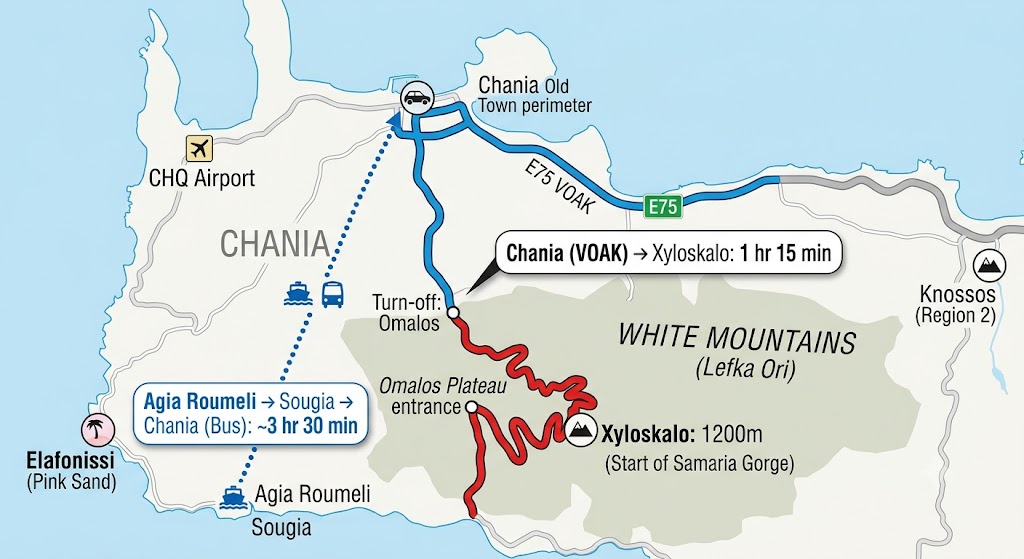
One of the best things to do in Crete is to discover Samaria gorge. It is the most famous hiking route in Greece. At 16 kilometres from the starting point at Xyloskalo (1,200 metres altitude) to the coastal village of Agia Roumeli, the walk descends through the White Mountains National Park, passing the abandoned village of Samaria, the Iron Gates (where the gorge narrows to 3 metres between 300-metre walls), and the chapel of Agios Nikolaos before arriving at the coast.
The logistics are well-organised in summer: most visitors travel by bus from Chania to the top (approximately 45 minutes), walk the gorge, and take a ferry from Agia Roumeli to either Chora Sfakion or Paleochora, where onward buses or pre-arranged transport return them to their accommodation. This chain works reliably but it requires understanding before you start it.
Critical: The Last Ferry from Agia Roumeli
Agia Roumeli has no road access. The only way out, apart from walking back the way you came, is by ferry. The last departure typically leaves between 5:30pm and 6pm (confirm current schedules before visiting. Timings vary by year and season). Visitors who start too late or walk slowly can miss this boat. This is not a theoretical risk, it happens every season. Plan your start time to complete the walk with at minimum 60 minutes of buffer before the last ferry. Most visitors start between 7am and 10am. Starting later than 1pm in peak season is inadvisable for most walkers.
What Other Guides Don’t Tell You About Samaria
- The first hour is the most physically demanding section. A steep descent of nearly 1,200 metres of altitude. Your knees bear the most strain here, not the final flat kilometres. Walking poles or trekking sticks help significantly.
- The Iron Gates, the famous narrow section, lasts approximately 10 minutes of walking. It is genuinely spectacular but brief. The gorge as a whole is varied and consistently interesting.
- The riverbed sections in the lower gorge require walking over rounded, wet limestone boulders. This is where inappropriate footwear causes most injuries. Proper hiking shoes with grip and ankle support are essential. Sandals and smooth-soled trainers are genuinely dangerous on these surfaces.
- Agia Roumeli has several decent tavernas where you can eat, drink cold water, and swim before your ferry. Build 60–90 minutes into your plan for this. It’s a more enjoyable end to the walk than standing in a queue.
- The gorge closes from mid-October to late April due to flood risk. Flash floods in the gorge have caused fatalities. The closure is a genuine safety measure, not bureaucracy.
- Drinking water is available at marked springs within the gorge. Carry at least 1.5 litres regardless.
- The Kri-Kri (Cretan wild ibex) lives in the gorge. Your best chance of seeing them is in the lower section, early in the morning before crowds arrive.
Imbros Gorge
The best alternative to Samaria for visitors who want a gorge walk without the crowds, the logistical complexity, or the five-to-seven-hour time commitment. At 8 kilometres one-way and relatively level through much of its length, the Imbros walk takes 2.5 to 4 hours depending on pace. The gorge walls close to around 2 metres at the narrowest section and the landscape (pale limestone, wild thyme and oregano, abandoned terraces) is classically Sfakian in character.
The walk begins in the village of Imbros and ends in Komitades, from where a taxi or pre-arranged pickup returns you to your vehicle. Unlike Samaria, there’s no ferry dependency and no altitude start, making it appropriate for families with older children and visitors who are fit but not experienced hikers. Year-round access (though check weather conditions before winter visits).
Agia Irini Gorge
A 10-kilometre gorge in the Selino region south of Chania, beginning near the village of Agia Irini and ending at the coastal village of Sougia. Significantly less visited than Samaria. The botanical diversity, native oaks, plane trees, Cretan dittany (diktamo), wild herbs, makes it particularly rewarding in spring and early summer. One-way route; return transport requires pre-arrangement or the summer coastal ferry service. Walking time 3–5 hours.
Gorge Comparison
| Gorge | Length | Difficulty | Walking Time | Crowd Level | Season | Best For |
|---|---|---|---|---|---|---|
| Samaria | 16 km | Moderate | 4–7 hours | Very High | May–Oct | The defining Cretan hike |
| Imbros | 8 km | Easy–Moderate | 2.5–4 hours | Low | Year-round | Families, non-expert hikers |
| Agia Irini | 10 km | Moderate | 3–5 hours | Very Low | Mar–Nov | Botanists, solitude seekers |
| Kourtaliotiko | 5 km | Easy | 1.5–2.5 hours | Low | Year-round | Combines well with Preveli Beach |
| Dead’s Gorge (Zakros) | 8 km | Moderate | 3–4 hours | Very Low | Mar–Nov | Combines with Zakros Palace |
| Rouvas | 8 km | Moderate | 3–4 hours | Very Low | Apr–Nov | Ancient oak forest, spring flowers |
Walking Crete’s Gorges Is Far Easier With Your Own Vehicle
The Samaria Gorge coach buses from Chania run on fixed times. Miss the last connection and your day becomes expensive and stressful. With a rental car you drive to the trailhead when you choose, typically before the coaches arrive, and arrange your own return from the coast.
For gorges like Imbros, Agia Irini, and the Dead’s Gorge at Zakros, there is simply no coach service. These are car-access destinations, full stop.
Panavia Trust has SUV and high-clearance options for mountain roads as well as compact cars for hikers who just need reliable access to trailheads.
See All Panavia Trust Vehicle Options!
The E4 Long-Distance Trail
The European E4 trail crosses Crete from Kissamos in the west to Kato Zakros in the east, covering more than 300 kilometres and passing through landscapes that are completely invisible from the main roads. It is rarely walked in its entirety by a single visitor, but its route provides a framework for day walks and multi-day sections through high mountain villages, ancient cobbled paths, shepherd shelters, and remote coastal terrain. A rental car is particularly practical for E4 hiking: park at one end of a day section, walk, and arrange a taxi or lift back to your vehicle. Several specialist hiking operators in Chania can provide guidance for specific sections.
Expert Tip: Footwear Is the Variable Nobody Mentions
The most common hiking mistake in Crete is footwear. Sandals and smooth-soled trainers are inadequate for gorge walking. The riverbed sections of Samaria and Zakros involve wet limestone and rounded boulders where grip is everything. Proper hiking shoes with ankle support are recommended for all gorge walks. For Imbros and Kourtaliotiko, sturdy trail runners are sufficient. Do not underestimate this. Most gorge injuries in Crete are footwear-related, not fitness-related.
Historic Towns and City Centres – Best things to do in Crete
All four of Crete’s main cities reward time that most visitors don’t give them. They are not simply logistics hubs between beach days, each one is a genuinely distinct urban environment with its own character, history, and areas of concentrated interest.
Chania Old Town
The old town of Chania is one of the most beautiful urban environments in Greece. The Venetian harbour, a horseshoe of pale stone quays with a restored 16th-century lighthouse at its entrance, is the most-photographed element, but it functions primarily as a backdrop for tourist restaurants. The real Chania lies in the lanes behind it.
The covered market (Agora), built in 1911 on a cross-shaped plan modelled on the market hall in Marseille, sells Cretan honey, mountain herbs, cheese, olive oil, and leather goods from stalls that have changed in character very little across decades. This is a working market for local suppliers, not a souvenir arcade. The old Jewish neighbourhood to the east of the harbour (Evraiki) retains Ottoman and Venetian domestic architecture in various states of preservation, much of it privately owned and gently decaying in a way that adds to rather than detracts from its atmosphere. The Splantzia neighbourhood, a short walk from the harbour, contains some of the most characterful back streets on the island.
Local Insight: Parking in Chania
Parking within or immediately adjacent to the old town is extremely limited and largely reserved for residents. Visitors arriving by rental car should use the municipal car parks near the eastern entrance of the old town, around Plateia 1866, or along the main approach road. Walk from there, the old town is compact enough that nothing is more than 10 minutes on foot from a reasonable parking point. Attempting to drive into the harbour area produces long delays and occasional contact with extremely narrow walls. The car parks charge a reasonable hourly rate and save significant time and frustration.
If you want to learn more about Chania, discover our post about ”Things to Do in Chania (2026): A Local’s Complete Guide”.
Rethymno Old Town
Rethymno contains the most complete Venetian urban fabric of any Cretan city. An old town of narrow lanes, ornate stone doorways, carved loggias, Ottoman minarets, and the enormous Venetian Fortezza that occupies a headland at the western end of the waterfront. The Fortezza is one of the largest Venetian military fortifications in the Mediterranean. Its interior, largely open and uncluttered by later additions, gives a genuine sense of the 16th-century military engineering that made Venice’s eastern Mediterranean possessions defensible.
Rethymno’s old town escaped the significant 20th-century redevelopment that changed Heraklion’s character, largely because the city was economically less dominant. The result is an urban landscape that, away from the main tourist street, still feels like a working Cretan town where people actually live rather than a preserved heritage zone.
Heraklion
Heraklion is the largest city in Crete and the one most visitors treat as a transit point. The Archaeological Museum alone justifies three hours. The Venetian Koules fortress at the harbour entrance is one of the best-preserved 16th-century military buildings in the eastern Mediterranean, you can walk along its roof for views over the old harbour. The central market street (1866 Street) is one of the most functional traditional markets in Greece: butchers, fishmongers, herb sellers, and cheese vendors serving local households, not tourist shops.
The El Greco Museum in Fodele (25 kilometres west of Heraklion) is small but the village itself, a working settlement in a valley famous for its orange groves, is worth the short detour for visitors interested in the painter born here as Doménikos Theotokópoulos. The drive takes 25 minutes and passes through attractive agricultural countryside.
If you want to learn more about Heraklion, discover our post about ”Things to Do in Heraklion (2026): A Local’s Complete Guide”.
Agios Nikolaos
The capital of Lasithi prefecture sits on a natural harbour connected by a narrow channel to a small inland lake (Voulismeni) that has no natural inlet or outlet and was long locally believed to be bottomless. The artificial channel was dug in 1870. The town is a pleasant, manageable base for east Crete, less hectic than the two western cities without feeling remote, and within easy driving distance of Spinalonga (26 kilometres), Elounda (10 kilometres), and the Lassithi Plateau (50 kilometres).
Sitia
Sitia, at the far northeast corner of the island, is perhaps the most authentically functional of Crete’s coastal towns. A real port city with a working fish market, a modest Venetian fortress, and a waterfront where local residents actually sit in the evenings alongside tourists. It receives a fraction of the visitors of the three larger cities and feels correspondingly more genuine. The town is the natural base for the far east: Vai, Zakros, Xerokampos, Toplou Monastery, and the remarkable Sitia Muscat wine region.
Monasteries, Castles and Venetian Heritage – Best things to do in Crete
Arkadi Monastery
Arkadi is the most historically significant monastery in Crete and one of the most important national monuments in Greece. In November 1866, during the Cretan revolt against Ottoman rule, several hundred Cretan fighters and civilians who had taken refuge within the monastery chose to detonate the powder magazine rather than surrender to the Ottoman besieging force. The explosion killed the majority of both sides. The event, known as the Holocaust of Arkadi, became central to Cretan national identity and galvanised European public opinion in favour of Cretan independence.
The monastery is an active working community with a beautiful 17th-century Venetian baroque church at its centre. The roofless powder magazine where the explosion occurred still stands and can be visited. The on-site museum contains items related to the 1866 siege and the wider Cretan resistance movement. Set in olive-covered hills 25 kilometres southeast of Rethymno, with a pleasant mountain road approach, it is among the most moving sites on the island for visitors with any knowledge of its context.
Spinalonga Island
A small island at the mouth of the Elounda Gulf in east Crete, accessible only by short ferry from Plaka, Elounda, or Agios Nikolaos. Fortified by the Venetians in 1579 and maintained as a stronghold for longer than almost any other Venetian possession in the eastern Mediterranean, Spinalonga served its final chapter as Europe’s last active leprosy colony from 1903 to 1957. The combination of Venetian military architecture and the largely intact village built for the leper colony creates a site that is historically layered and, in the context of those last inhabitants, genuinely sobering.
Victoria Hislop’s novel The Island, set on Spinalonga, significantly increased visitor numbers after its 2005 publication and BBC television adaptation. Summer ferries run throughout the day. The walk around the interior takes 45 minutes to an hour and is partially accessible to visitors with limited mobility, though the terrain is uneven. Arriving on the first ferry of the morning gives the most atmospheric experience before the midday crowds.
Toplou Monastery
One of the most important monasteries in Crete, Toplou has served across its history as fortress, resistance refuge, and active monastic community. Located in the northeast near Sitia, it receives fewer visitors than Arkadi but is architecturally and historically significant. Its most famous possession is a large 18th-century icon by Ioannis Kornaros containing 61 individual scenes arranged around a central figure, each one illustrating a phrase from the Orthodox liturgy, the most complex and detailed icon on the island. The monastery produces a respected wine, sold at the monastery shop and in specialist retailers in Heraklion and Sitia.
Venetian Fortifications
The Venetian period in Crete (1204–1669) left a remarkable architectural legacy across the island beyond the three major fortresses. Venetian civic buildings (fountains, loggia, gateway arches, domestic doorways) still define the character of the old towns. The Rimondi Fountain in Rethymno (1626), the Loggia in Heraklion (now the town hall), the Venetian gate at Chania’s old town entrance, and dozens of identified doorways in the backstreets of all three cities represent the sustained administrative presence of a maritime empire that held Crete for over four centuries.
Good to Know: Monastery Visiting Etiquette
Active monasteries in Crete welcome visitors but observe dress codes. Shorts are not permitted for entry. Men and women should have knees and shoulders covered. Most monasteries near tourist areas keep a supply of sarongs or wrap-skirts for visitors who arrive unprepared. Photography restrictions vary: always ask before photographing inside a church, and always comply with posted restrictions. Visiting hours are typically 9am–1pm and 3pm–7pm; some monasteries close at midday. Admission is usually free or a modest donation is expected.
Mountain Villages and Remote Landscapes – Best things to do in Crete
The mountains of Crete are where the island’s character was shaped and where, in many ways, it remains most intact. During the Ottoman occupation, the mountain communities sustained resistance that the coastal populations could not. During the Second World War, the Cretan resistance operated from the high villages. The traditions, dialect, food, and music of the mountain communities have preserved an authenticity that the coastal resort economy has eroded almost everywhere below 400 metres.
None of these destinations are accessible without a car. Several require comfort with mountain driving.
The Lassithi Plateau
The Lassithi Plateau is a large upland basin at approximately 840 metres altitude in the Dikti Mountains, surrounded by bare limestone peaks, reached by spectacular mountain roads from the north via Heraklion or Neapoli, or from the east via Agios Nikolaos. The plateau is a working agricultural landscape, cultivated continuously for thousands of years, currently devoted mainly to apple orchards, potatoes, and market vegetables and was until recently famous for its thousands of white-sailed windmills used for irrigation. Most windmills are no longer in use, but the setting remains striking.
The Dikteon Cave (Psychro Cave) on the plateau’s western flank is, in Greek mythology, the birthplace of Zeus. Archaeological evidence confirms cult activity here from the Minoan period through to the Hellenistic. The cave is a genuinely impressive geological formation. A large cavern with stalactites and stalagmites, though interpretation inside the site is limited. The drive to the plateau is itself one of the most dramatic on the island, with views back to the north coast from the upper pass that extend on clear days to the Turkish coast.
Driving Note: The Road to Lassithi
The main approach via the Seli Ambelou pass involves 25 kilometres of continuous hairpin bends from the junction near Neapoli. Standard cars handle it without mechanical difficulty. The road is fully paved throughout. Allow 45–60 minutes from the north coast junction to the plateau floor. Drive slowly, use lower gears on descent, and be prepared for oncoming traffic on blind bends. In winter and early spring, the plateau can receive snow and the road may be temporarily closed. Check locally before attempting it between December and March.
Archanes
Archanes is a small town 15 kilometres south of Heraklion that deserves significantly more attention than it receives. It sits at the centre of one of Crete’s most important wine-producing areas. The Archanes appellation is the source of some of the island’s best red wines from the Kotsifali and Mandilari grapes and has a remarkably well-preserved vernacular architecture of traditional stone buildings, decorative doorways, and shaded squares. The local archaeological museum holds finds from the nearby Anemospilia site, where evidence of Minoan ritual human sacrifice was discovered in 1979. One of the most controversial finds in Aegean archaeology. The village market sells cheeses, raki, and table grapes of a quality not easily replicated elsewhere.
The Amari Valley
The Amari Valley runs north–south between the south face of Mount Ida and the Kedros range, containing approximately 40 small villages and one of the most concentrated collections of Byzantine-frescoed churches anywhere in Crete. Many date from the 13th to 15th centuries and contain paintings of considerable quality that are completely uncommercialised. Sometimes literally locked, with keys available from the nearest kafenio. The valley is reached from Rethymno via Apostoli (approximately 30 kilometres), and a circular drive through it, pausing at the church of Agios Nikolaos near Meronas, the plateia of Thronos with its panoramic views, and the monastery at Asomatos, takes a half-day with a car and produces an experience of authentic rural Crete that the coast cannot offer.
Sfakia and the South Sfakian Coast
The Sfakia region in the White Mountains hinterland is the most remote inhabited part of western Crete. It is the only part of the island never fully controlled by the Ottomans, which gives it a particular character. Fiercely independent, culturally conservative, and with a self-reliance that is apparent in the landscape and in the people. The village of Chora Sfakion is accessible by car via a spectacular road from Vrisses. From the port, the coastal ferry connects the otherwise road-inaccessible villages of Loutro, Glyka Nera, and Agia Roumeli. The combination of sea and mountain here and the complete absence of tourist development beyond the basics, makes the region one of the most genuine parts of the island for travellers who have already seen the obvious highlights.
Anogia
The most famous mountain village in Crete and the one most associated with the island’s musical tradition. Anogia is known throughout Greece for its lyra music, the Cretan bowed lyre that is the defining instrument of the island’s folk tradition, for its raki, its wool weaving, and for its twice-burned history: the village was destroyed by German forces in 1944 as a reprisal for the resistance’s role in the abduction of General Heinrich Kreipe. The rebuilt village maintains a tradition of woven textiles (the women’s cooperatives produce rugs and bags of genuine craft quality) and a weekly market selling mountain herbs, honey, and cheese that is among the best on the island.
Every Village in This Section Requires a Car to Reach
The Lassithi Plateau, the Amari Valley, Anogia, the Sfakia hinterland, Archanes. None of these are on any tourist excursion route, and the KTEL schedule for mountain areas ranges from infrequent to non-existent. These are the parts of Crete that most visitors never see, for exactly this reason.
Panavia Trust delivers directly to your accommodation. Your car is there on arrival, no office visit required.
Book Your Rental Car with Panavia Trust!
Cretan Food, Wine and Local Experiences – Best things to do in Crete
Cretan cuisine carries UNESCO recognition as part of the Mediterranean diet heritage and has a genuine claim to being one of the healthiest and most distinctive food traditions in Europe. What makes it unusual beyond the obvious quality of the ingredients and the olive oil and vegetables here are genuinely exceptional, is the degree to which the food culture remains embedded in daily life rather than preserved as a tourist performance. Local people eat the way guidebooks describe Cretan food, because this is genuinely how they eat.
Essential Dishes and Products
| Dish / Product | What It Is | Where to Find the Best |
|---|---|---|
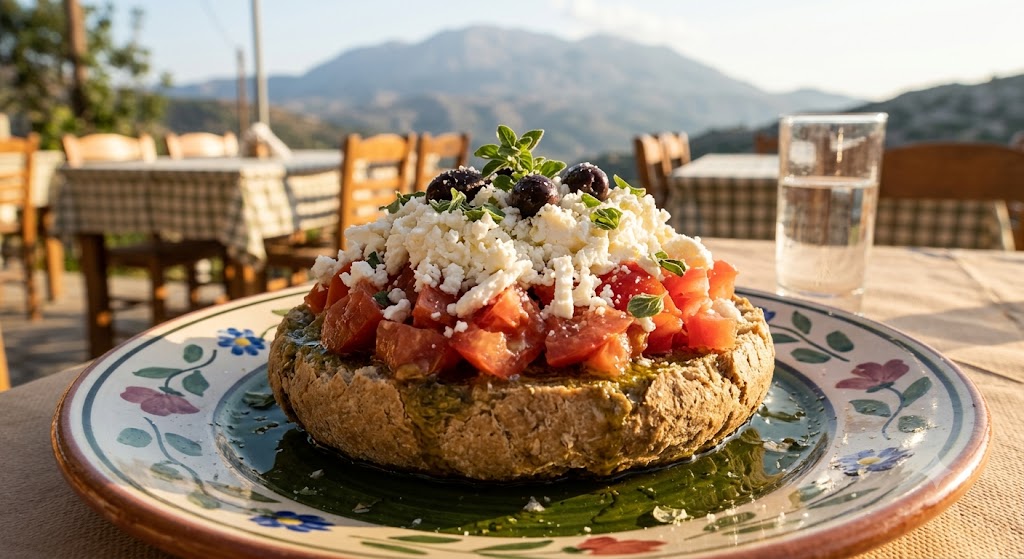
| Dakos | Barley rusk soaked in olive oil and tomato, topped with mizithra cheese and olives. Often called “Cretan bruschetta”, a considerable undersell. | Traditional tavernas throughout the island; mountain village tavernas tend to use locally produced rusks that are noticeably superior |
| Slow-roasted lamb (antikristo or kleftiko style) | Traditional mountain preparation: lamb slow-cooked for hours over embers or in a wood oven until it collapses off the bone. Not on every menu. Found at village festivals and specialist tavernas. | Village festivals (panigiria); specialist tavernas in Sfakia and Anogia |
| Graviera | Hard cheese with a distinctively nutty, slightly sweet character. The Rethymno version carries PDO status. | Any market; directly from village cheese producers in the Amari Valley; Chania Agora |
| Mizithra | Fresh whey cheese — mild, creamy, used in both savoury and sweet preparations. Vastly better fresh from a village producer than from a supermarket. | Local markets; cheese shops in Chania Agora and Heraklion central market |
| Snails (boubouristi) | Cretan snails fried in a pan with rosemary, vinegar, and olive oil. A regional speciality that divides visitors and is worth trying once. | Traditional tavernas, particularly in west Crete and Heraklion |
| Cretan olive oil | Crete produces approximately 30% of all Greek olive oil. PDO varieties from Sitia and Kolymvari are among the most awarded in Greece and much of Europe. | Direct from producers; Chania Agora; Heraklion central market; specialty food shops |
| Tsikoudia (Raki) | Grape marc spirit, usually colourless, served without charge at the end of a meal in a traditional taverna. The offering of raki is a genuine gesture of hospitality. Refusing it is perfectly acceptable but accepting it is usually appreciated. | Any traditional taverna; Anogia is its spiritual home |
| Thyme honey | Cretan thyme honey from the White Mountains is among the most prized in Greece, darker, more aromatic, and more complex than most commercially available honey in Europe. | Mountain village shops; Anogia market; Chania Agora; Heraklion market |
| Cretan herbs (diktamo, malotira, thyme) | Diktany of Crete (diktamo) is endemic to the island and used as a herbal tea. Mountain tea (malotira) is the most commonly served herbal tea. Both are available dried to take home. | Market stalls throughout Crete; mountain village shops where freshly dried |
Wine Touring in Crete
Crete has the largest area under vine of any Greek region and a wine tradition stretching back to the Minoan period. Minoan fresco evidence suggests sophisticated wine production by 1500 BCE. The island’s indigenous varieties are almost entirely unknown outside Greece but produce wines of genuine quality, particularly since the generation of winemakers who trained in France and Italy returned to Crete from the 1990s onwards.
Wine Regions of Crete
| Wine Region | Location | Key Varieties | Notable Feature |
|---|---|---|---|
| Archanes | 15 km south of Heraklion | Kotsifali, Mandilari (red); Vidiano (white) | Closest wine region to Heraklion; several wineries with visitor facilities |
| Dafnes | 20 km south of Heraklion | Liatiko (red) | Small PDO; distinctive lightly tannic reds sometimes compared to Pinot Noir in aromatic character |
| Peza | 25 km southeast of Heraklion | Kotsifali, Mandilari, Vilana | Largest appellation; large cooperative; good introduction to Cretan wine at scale |
| Sitia | Far east Crete | Liatiko (red); Muscat (sweet white PDO) | Toplou Monastery wine; remarkable sweet Muscat; most remote wine region |
| Kissamos / Kastelli | Northwest Crete | Romeiko, Vidiano, Thrapsathiri | Newer appellations; interesting natural and biodynamic producers emerging |
Planning Tip: Wine Touring by Car
Cretan wineries are not clustered together like Bordeaux châteaux. They tend to be spread across hillside landscapes without much physical proximity to each other. A wine touring day works best planned in advance: contact wineries directly to confirm visiting hours (many require appointments and have limited visitor hours), designate a driver, and plan two to three stops maximum to allow genuine tasting and conversation. Most wineries sell directly at prices below retail. The Archanes region is the most practical for visitors based in Heraklion. Three or four quality producers are within a 20-minute drive of the town.
Village Festivals (Panigiria)
The most authentic food and cultural experience available in Crete and the least known to most visitors, is the village festival (panigiri), held throughout summer and autumn in honour of patron saints. These events, typically on the eve of the saint’s day, involve the entire village: open-air cooking of traditional dishes (particularly lamb and kid goat slow-cooked over wood fires), live lyra and laouto music, and communal dancing that continues until dawn. As a visiting stranger who arrives respectfully, you will almost invariably be welcomed, offered food, and given raki. Dates are fixed by the Orthodox liturgical calendar. Your accommodation owner or a local kafenio will know what’s coming up in the area during your stay.
Exploring the best foods Crete offers by reading more on ”Culinary Journey Through Crete”!
Sea Activities and Boat Trips – Best things to do in Crete
Boat Trips and Coastal Ferries
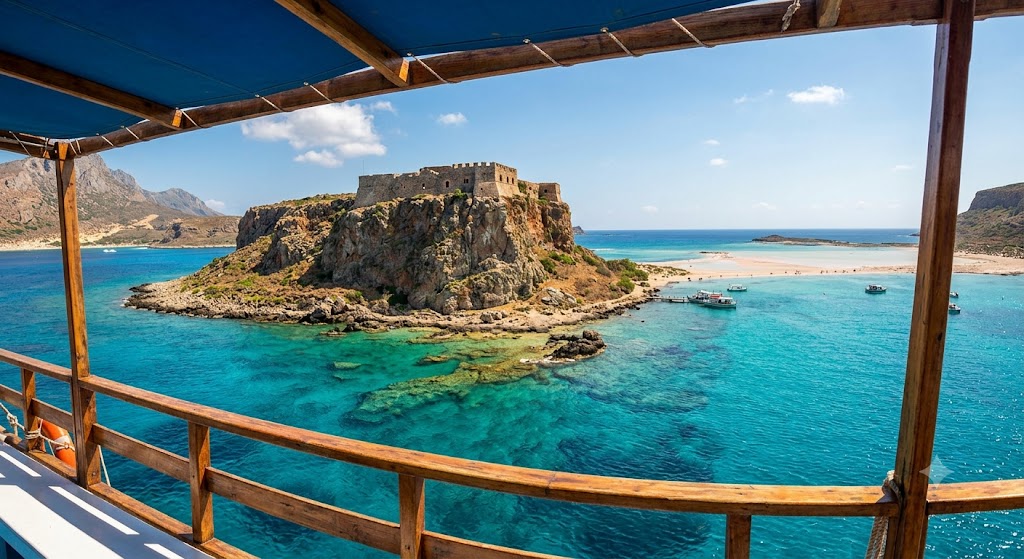
Several of Crete’s most spectacular destinations are better reached by sea than by road. The coastal ferry services that operate from May through September create access to villages and beaches that would otherwise require hours of mountain driving or that have no road access at all.
Boat Trips and Ferry Routes
| Departure Port | Destinations Served | Crossing Time | Notes |
|---|---|---|---|
| Kissamos | Balos Lagoon, Imeri Gramvousa island and castle | Full day excursion | Typically departs 10am and 11am in season; weather-dependent. The meltemi wind can cancel departures for multiple consecutive days |
| Plakias / Agia Galini | Preveli Beach | Half day | Summer service; access to the palm beach without the walk from the upper car park |
| Elounda / Plaka / Agios Nikolaos | Spinalonga Island | 15–30 minutes | Multiple departures daily in summer; book ahead in peak weeks |
| Chora Sfakion / Paleochora | Loutro, Agia Roumeli, Sougia, Glyka Nera | 30 min to 2 hours | The south coast ferry connecting otherwise roadless villages; essential for Samaria walkers |
| Chania / Heraklion | Various south coast cruises | Full day | Multiple operators; check current schedules and offerings seasonally |
Scuba Diving
One of the best things to do in Crete is Scuba diving. Crete offers excellent diving conditions: water clarity of 20–30 metres in ideal conditions, varied topography including sea caves, drop-offs, and limited wreck diving, and a marine environment that, outside the organised beach areas, is largely intact. Well-established dive centres operate at Heraklion, Chania, Rethymno, Agios Nikolaos, Elounda, and several coastal resorts. Regulations permit recreational diving throughout most of the coastline except officially designated archaeological zones. Several areas have submerged ancient remains that are legally protected, and reputable operators will not dive within them.
September and October are widely considered the optimal diving months: sea temperature still 23–25°C from summer, visibility at its best, and the surface conditions that can affect summer diving have typically subsided. Most centres offer PADI courses for beginners and guided boat dives for certified divers.
Sea Kayaking
The south coast of Crete, particularly the stretch between Paleochora and Chora Sfakion, offers outstanding sea kayaking when conditions are calm. The combination of cliffs, sea caves, completely inaccessible beaches (visible but unreachable by land or boat except by kayak), and clear water makes this one of the more exceptional paddle environments in the Mediterranean. Several operators in Chania, Paleochora, and Agia Galini run guided tours from half-day introductory sessions to multi-day expeditions with camping on isolated beaches. The best conditions for paddling are from May through June and from September through October when the meltemi wind is absent or minimal.
Snorkelling
Good snorkelling in Crete requires a rocky or mixed seabed with clear water. Conditions found at dozens of less-visited coves. Some practical options: the rocky edges of the Elafonissi island (away from the main sandy areas), the points at either end of Falasarna, the offshore rocks at Agios Pavlos, and the rocky sections flanking many of the organised north coast beaches. Equipment is available for rent at most organised beach facilities. The marine life is not as spectacular as in tropical destinations but the clarity and the occasional encounter with octopus, sea bream, and Mediterranean grouper are reliably enjoyable.
Nature, Wildlife and Outdoor Adventures – Best things to do in Crete
The White Mountains National Park
The Lefka Ori (White Mountains) National Park is the largest protected area in Crete and one of the most ecologically significant in Greece. Beyond the gorges, the high mountain landscape is a different and far less visited environment: bare limestone plateaux (poljes), endemic plant species found nowhere else on earth, and the Kri-Kri the Cretan wild ibex (Capra aegagrus cretica), an endemic subspecies that survives in the wild only here and on a few small offshore islands. Kri-Kri sightings in the Samaria Gorge are most likely in the lower gorge sections in the early morning before visitor crowds arrive. On the offshore islands of Dia and Agios Theodoros, protected Kri-Kri populations are visible at closer range from a boat.
Birdwatching
Crete sits on a significant Mediterranean migratory flyway and receives substantial passage migrant numbers in spring and autumn. The island supports breeding populations of birds of particular conservation interest: Eleonora’s Falcon (breeding on offshore islets, frequently visible in late summer hunting swallows and swifts), Griffon Vulture (best seen in thermals over the gorges and White Mountains), Bearded Vulture (Lammergeier, occasional over the highest mountain terrain), and Blue Rock Thrush. The Almyrida wetland near Chania, the Lassithi Plateau, and the Elafonissi lagoon are consistently productive birdwatching sites. Spring migration (April–May) is the most active period for species diversity.
Road Trips and Scenic Drives
Some of the most rewarding experiences in Crete are simply the drives between destinations. The following routes reward a slow pace and a willingness to stop:
- Chania to Elafonissi via the south coast road: The coastal route through Paleochora rather than the direct inland road adds 30 minutes but passes through dramatically different terrain. Olive groves, small fishing harbours, and south coast sea views rarely seen by visitors.
- The Sfakian route (Vrisses to Chora Sfakion): A 36-kilometre mountain road of extraordinary scenic intensity. The descent to the coast from Imbros village produces views of the Libyan Sea that stop most drivers at every available viewpoint.
- The Amari Valley loop from Rethymno: A circular half-day drive through Byzantine churches, working villages, and mountain panoramas. Completely uncommercialised.
- Heraklion to Sitia via the north coast: The E75 here passes through a stretch of coastline with dramatic karst geology and several good stopping points between Agios Nikolaos and Sitia.
- The road to Zakros: The last 30 kilometres from Sitia to Zakros drops through increasingly remote limestone terrain to the east coast. The final descent to Kato Zakros is one of the most rewarding road sequences on the island.
Cycling
Road cycling in Crete is increasingly popular among visiting cyclists despite the demanding terrain. The island’s north–south topography means most interesting routes involve substantial climbing. The most practical cycling areas for visitors are: the Heraklion wine country (rolling hills, moderate gradients), the coastal path between Chania and Georgioupolis (flat, partially traffic-free), and the Amari Valley (challenging but outstandingly scenic). Mountain biking is possible in numerous locations; several operators in Chania and Rethymno run guided downhill and trail excursions.
Rock Climbing
The limestone walls of Cretan gorges and mountains contain thousands of climbing routes across all difficulty grades. The most developed climbing areas are near Kalyves and Almyrida on the north Chania coast, the Agia Triada sector near Chania, and several gorge walls in the Sfakia region. The climbing season runs October through May, summer temperatures at lower elevations make climbing both physically uncomfortable and genuinely dangerous at most sectors. A specialist guidebook (available in Chania) is the standard reference for independent climbers.
Suggested Itineraries for Crete – Best things to do in Crete
The frameworks below assume a rental car and accommodation flexibility. They are starting points, not schedules, adjust based on your interests, pace, and the month you’re visiting. Every itinerary here has been planned with driving times verified against actual Cretan road conditions, not mapping-app estimates that ignore mountain road reality.
How Much Time Do You Realistically Need?
A week covers one region thoroughly and allows a day trip or two into a neighbouring area. Two weeks allows genuine island-wide exploration. Less than five days means making clear choices about priorities. Trying to see everything in three days produces a driving holiday with insufficient time at any destination. The table below helps calibrate expectations.
3-Day Itinerary: West Crete from Chania
| Day | Morning | Afternoon | Evening |
|---|---|---|---|
| Day 1 | Arrive Chania Airport. Collect rental car. Check in to accommodation. Rest. | Explore Chania Old Town: Venetian Harbour, Agora market, Splantzia neighbourhood | Dinner in the old town. One street behind the harbour for better quality and value |
| Day 2 | Early departure (7:30am) to Elafonissi. Arrive before 9am for best conditions. | Return via Paleochora (lunch). Or drive to Falasarna for a second, quieter beach. | Back to Chania |
| Day 3 | Drive to Balos car park. Arrive by 10am. Walk down to the lagoon. | Return to Kissamos for lunch. Imeri Gramvousa boat option if conditions allow. | Sunset at Falasarna if energy allows |
5-Day Itinerary: Best of Crete (West-Focused)
| Day | Focus | Key Stops |
|---|---|---|
| Day 1 | Chania arrival and orientation | Chania Old Town, Agora market, evening harbour |
| Day 2 | West Crete beaches | Elafonissi (early), Paleochora lunch, Falasarna sunset |
| Day 3 | Samaria Gorge (if fitness allows) or Imbros alternative | Gorge walk, Agia Roumeli swimming and lunch, ferry to Chora Sfakion, drive back |
| Day 4 | Drive east to Rethymno | Arkadi Monastery (morning), Rethymno Old Town, Fortezza, evening in Rethymno |
| Day 5 | South Crete loop | Preveli Beach, Plakias lunch, Agios Pavlos, return to Rethymno or Chania |
7-Day Itinerary: Full Island
| Day | Focus | Key Stops |
|---|---|---|
| Day 1–2 | West Crete | Elafonissi, Balos, Falasarna, Chania Old Town, Akrotiri Peninsula |
| Day 3 | Gorge and south coast | Samaria or Imbros Gorge, Chora Sfakion, south coast ferry to Loutro |
| Day 4 | Rethymno and central | Arkadi Monastery, Rethymno Fortezza, drive east, Amari Valley detour if time allows |
| Day 5 | Heraklion and archaeology | Knossos (arrive at opening), Heraklion Archaeological Museum, Heraklion evening |
| Day 6 | East Crete | Agios Nikolaos, Spinalonga Island, Elounda, Lassithi Plateau drive |
| Day 7 | Far east or south | Sitia, Toplou Monastery, Vai, Zakros or Phaistos and Matala from Heraklion |
Quick Decision Guide by Traveller Type
| If You Are… | Prioritise | Best Base | Vehicle Recommendation |
|---|---|---|---|
| Family with young children | Elafonissi, Lassithi Plateau, Chania town, Imbros Gorge, organised north coast beaches | Chania or Rethymno area | Compact or mid-size; automatic if drivers prefer |
| Couple on first visit | Balos, Chania Old Town, Arkadi, Rethymno, Preveli | Chania or Rethymno | Economy or compact |
| History and culture focus | Knossos, Heraklion Museum, Phaistos, Gortyn, Rethymno, Spinalonga, Arkadi | Heraklion | Economy. Distances are short |
| Active traveller / hiker | Samaria, E4 trail sections, White Mountains, sea kayaking, Sfakia | Chania or Sfakia village | SUV or high clearance for Sfakia roads |
| Returning visitor | Amari Valley, Xerokampos, Agios Pavlos, far east villages, Sfakia, wine touring | Agios Nikolaos or village accommodation | SUV for remote tracks |
| Food and wine traveller | Heraklion market, Archanes wineries, Anogia, village festivals, Sitia Muscat | Heraklion or Archanes | Economy. Wine country distances are short |
| Photographer | Balos (afternoon light), Falasarna (sunset), Chania Old Town (golden hour), Lassithi (dawn) | Chania | Any. Prioritise early start timing |
Every Itinerary in This Guide Was Built Around Having a Car
The 3-day, 5-day, and 7-day itineraries above are designed for independent travellers with a vehicle. Without one, they either collapse logistically or shrink to whatever organised excursions happen to be available on the days you need them.
Panavia Trust delivers to both airports and to hotels, ports, and addresses across all four prefectures. If your itinerary starts in Chania and ends in Heraklion, they can arrange one-way rentals accordingly.
Plan Your Trip with Panavia Trust! & Discover All Pickup & Delivery Locations!
Seasonal Guide: When to Do What in Crete
Crete has a wider climate range than most visitors expect. The island receives mountain snow from December through April, temperatures exceeding 38°C on the south coast in July and August, spring wildflower blooms that rival anything in southern Europe, and an autumn period that most experienced travellers consider the island’s best-kept secret. Choosing the right season for your priorities changes the experience significantly.
When to Visit Crete: Season by Season
| Season | Months | Temperature | Sea Temp | Crowd Level | Best For | Limitations |
|---|---|---|---|---|---|---|
| Early Spring | March–April | 15–22°C | 16–18°C | Very Low | Hiking, gorges, wildflowers, archaeology, photography, driving with empty roads | Swimming uncomfortable for most; Samaria Gorge usually closed until May; some seasonal businesses not yet open |
| Late Spring | May–June | 22–29°C | 20–23°C | Low–Moderate | The optimal all-round period: good weather, swimmable sea, manageable crowds at most sites, all attractions open | Elafonissi becomes busy from mid-June; book popular accommodation in advance |
| Peak Summer | July–August | 30–38°C | 25–27°C | Very High | Beach swimming, boat trips, evening towns, water sports | Midday hiking dangerous; popular beaches crowded by 10am; meltemi wind disrupts boat trips; Knossos and major sites heavily visited; mountain driving in peak heat inadvisable midday |
| Early Autumn | September–October | 25–30°C | 24–26°C | Moderate → Low | The best period for most experienced travellers: warm sea, excellent diving visibility, thinning crowds, all attractions still open, olive harvest begins in October | Samaria Gorge closes mid-October; some south coast businesses begin closing end of October |
| Late Autumn | November | 18–22°C | 21–23°C | Very Low | Archaeology, towns, food tourism, olive harvest experience, authentic local life | Beach swimming becoming cold; some remote south coast areas close down; occasional heavy rain |
| Winter | December–February | 10–16°C | 16–18°C | Minimal | Authentic Crete experience in cities; Heraklion and Chania locals-only atmosphere; specialist winter hiking and ski touring in the White Mountains | Many tourist businesses closed; south coast beaches inaccessible in poor weather; mountain roads require local advice before attempting |
Whenever You Visit, the Logic Is the Same
Spring hiking, summer beaches, autumn wine country, winter driving through empty mountain roads. Every season in Crete produces a different reason to have independent transport. The island doesn’t get smaller in October. The gorges don’t move closer to bus stops in May.
Panavia Trust operates year-round with delivery across Crete. Early and late season availability is typically better and prices are lower. Worth planning ahead.
Check Availability of Panavia Trust!
The Meltemi Wind: What Visitors Need to Know
The meltemi is a dry northerly wind that blows across the Aegean in summer, particularly in July and August. In Crete, it affects the north coast primarily, creating rough sea conditions that can cancel boat departures from Kissamos (Balos excursions) for multiple consecutive days, producing sand conditions on exposed north coast beaches, and reducing temperatures by 3–5°C compared to sheltered south coast locations. The south coast is largely protected from the meltemi by the island’s mountain spine. The wind typically blows for 2–5 day periods rather than continuously.
Practical consequences: always check sea conditions before booking a boat excursion in July and August, and have a land-based alternative prepared. The meltemi is not predictable enough to plan around in advance. It requires flexibility on the day.
The Olive Harvest: An Autumn Experience
The Cretan olive harvest runs from October through December depending on altitude and variety. In many parts of the island, particularly in the Kolymvari area of northwest Crete and in the olive groves of the Messara plain, the harvest is a significant community event. Some agrotourism operations offer harvest participation experiences. A half-day of picking followed by a meal and raki. Contact the relevant local tourism organisations or agrotourism farms directly for current opportunities. It is not something you can spontaneously join, but with advance planning it’s a genuinely memorable experience.
Practical Planning Tips for Visiting Crete
Getting Around: The Transport Reality
Crete’s KTEL bus network is reliable and inexpensive on the main north coast axis (Heraklion–Rethymno–Chania–Agios Nikolaos). Beyond this, it becomes sharply limited. The following destinations have no practical public transport access:
- Elafonissi (limited summer service from Chania; infrequent and timing-constrained)
- Agios Pavlos
- Xerokampos
- Lassithi Plateau (limited and infrequent service)
- Amari Valley villages
- Sfakia hinterland (Anopolis, Aradena, the plateau villages)
- Preveli (seasonal, infrequent)
- Most mountain villages
- Far east coast (Zakros, Xerokampos)
Taxis and organised excursions fill some gaps, but both impose constraints. Taxis become expensive for longer distances, and excursions operate on fixed timing with fixed groups. Only independent transport gives you the combination of geographic reach and timing flexibility that Crete’s scale and spread requires.
For a detailed guide on choosing the right rental company, vehicle category, insurance, and pickup options across the island, see our complete Best Car Rental in Crete guide.
Driving in Crete: What to Know in Advance
| Road Type | Condition | Notes for Visitors |
|---|---|---|
| E75 north coast highway | Dual carriageway, well-maintained | Speed cameras are common; posted limits are enforced; local drivers can be assertive at overtaking; keep right unless passing |
| Regional main roads | Paved, single carriageway | Narrow in places; intermittent road damage in remote areas; slow behind agricultural vehicles. Pass only where clearly safe |
| Mountain roads | Paved but narrow and winding | Hairpin bends are tighter than they appear on maps; use low gears on descent; sound horn before blind bends on mountain passes; allow more time than mapping apps suggest |
| Unpaved access tracks | Gravel or dirt | Balos track passable for standard cars at slow speed; some remote tracks in east Crete require higher clearance; always verify before committing to a track you haven’t researched |
For a complete breakdown of Crete’s road types, mountain passes, local driving etiquette, fuel stations, parking, insurance, and the most rewarding scenic routes across the island, see our dedicated Driving in Crete guide.
Practical Driving Notes
- Fuel stations are common on main roads but can be 30–50 km apart in rural and mountain areas. Fill up whenever you see a station if you’re heading into remote terrain.
- Download offline maps for Crete before leaving your accommodation’s WiFi, mobile connectivity is unreliable in mountain areas and some gorge roads.
- Parking in Chania and Rethymno old towns: use municipal car parks on the perimeter and walk in. Both old towns are compact enough that nothing requires more than a 10-minute walk from a sensible parking point.
- Animals on roads: sheep, goats, and occasionally cattle cross freely in rural areas, particularly at dawn and dusk. Reduce speed in farming areas near grazing land.
- The meltemi wind affects exposed ridge roads in the west. You will feel it in the steering. Reduce speed and maintain lane discipline on the Balos approach road and the Falasarna coastal section when the wind is strong.
Choosing Your Rental Vehicle
| Vehicle Category | Best Suited For | Limitations in Crete Context |
|---|---|---|
| Economy / small hatchback | City use, north coast highway, most paved roads, light packing | Less comfortable on rough tracks; limited boot space for beach gear and luggage |
| Compact or mid-size | Most tourist itineraries; all paved roads including mountain routes; comfortable for 2–4 passengers | Rough tracks manageable but slow; this is the right choice for the majority of visitors |
| SUV / high clearance | Balos track; remote east Crete; Sfakia mountain roads; full island exploration including unpaved routes | Higher fuel cost; less straightforward to park in narrow old town streets |
| Automatic transmission | Drivers less experienced with manual on steep continuous mountain descents | Confirm availability with your rental provider in advance, not always available across all categories |
Budget Planning Reference
| Category | Budget | Mid-Range | Comfort |
|---|---|---|---|
| Accommodation (double, per night) | €40–70 (studios, rooms) | €80–150 (small hotels, apartments) | €150–350+ (boutique hotels, villas) |
| Food (per person per day) | €20–30 (bakeries, local tavernas) | €35–55 (tavernas, one restaurant meal) | €60–100+ (restaurants, wine) |
| Rental car (per day, all-in) | €12–45 (economy) | €50–75 (compact / mid-size) | €80–130+ (SUV or premium) |
| Fuel (per day, moderate driving) | Approximately €15–30 depending on distances driven and fuel prices | ||
| Major site entry fees | Knossos €15 · Heraklion Museum €15 (or combined ticket) · Phaistos €8 · Gortyn €8 · Spinalonga €8 · Arkadi donation | ||
| Samaria Gorge | €5 park entry + ferry from Agia Roumeli approximately €12–15 | ||
What to Pack
- Sun protection: SPF50+ sunscreen, lip SPF, sun hat, sunglasses. The Cretan sun at altitude or on south-facing beaches is considerably stronger than northern European experience prepares most visitors for.
- Footwear: Hiking shoes or trail runners for gorges and mountain walks; sandals for towns; water shoes for rocky beaches. Do not attempt gorge walks in smooth-soled trainers or sandals.
- Layers for altitude: The Lassithi Plateau, the White Mountains, and high village areas run 8–12°C cooler than the coast even in summer. An extra layer for evenings at altitude.
- Cash: Many smaller tavernas, village shops, and car park attendants accept cash only. Keep €50–100 in small denominations.
- Reusable water bottle: Tap water in most Cretan towns is drinkable; refillable at springs in gorges. A 1-litre reusable bottle reduces single-use plastic significantly.
- Offline maps: Download Crete offline in Google Maps or Maps.me before your first drive into remote terrain. Mobile connectivity is unreliable in mountain areas.
- Adaptor: Greece uses Type C and F sockets (standard European two-pin). UK and US visitors need an adaptor.
What Travellers Say About Exploring Crete with Panavia Trust
Independent travellers who rented through Panavia Trust on what made the difference.
“I’d read that Crete was manageable by bus. It isn’t. Not if you want to see the real island. Panavia Trust delivered the car to our hotel in Rethymno at 8am on day two. By that afternoon we’d been to Arkadi Monastery, driven through the Amari Valley, found a village with a Byzantine church that had frescoes from the 1300s, and had lunch at a kafenio where we were the only non-locals. None of that is on any excursion itinerary.”
— Marco D., Italy — October
⭐⭐⭐⭐⭐
“The car delivery to Heraklion Airport was seamless. The vehicle was exactly what was agreed, the handover took ten minutes, and we were on the road to Knossos before the airport coaches had even loaded. For two weeks of driving including mountain roads and the Balos track, the car performed perfectly. Genuinely the best decision we made for this trip.”
— Thomas & Anna K., Germany — June
⭐⭐⭐⭐⭐
“We’re a family with two young children. Panavia Trust helped us choose a larger vehicle with enough boot space for all our beach gear. They delivered to our apartment in Chania at 9am on day one. We did Elafonissi, the Lassithi Plateau, a gorge walk at Imbros, and a dozen smaller beaches we’d never have found otherwise. The kids still talk about the wild goats on the mountain road.”
— Claire & David M., Ireland — July
⭐⭐⭐⭐⭐
“I visit Crete every two years. Every time I rent from Panavia Trust. This time I asked for an SUV because I wanted to drive the south coast tracks and explore some of the remote east. The vehicle was exactly right. The team knew the roads I was asking about and gave me practical advice before I set off. That local knowledge is as valuable as the car itself.”
— Henrik L., Sweden — May
⭐⭐⭐⭐⭐
“I was travelling solo for ten days and wanted maximum flexibility. Panavia Trust delivered a compact automatic to Chania Airport. I drove the whole island, west coast beaches, Samaria Gorge start point at 7am, the Sfakia road, across to Heraklion, down to Matala, and out to Zakros. One-way return to Heraklion Airport at the end. No issues, no surprises, completely straightforward.”
— Rachel B., Australia — September
⭐⭐⭐⭐⭐
Book Your Vehicle with Panavia Trust!
Heraklion Airport · Chania Airport · Hotels · Ports · Anywhere on the island.
Frequently Asked Questions About Things to Do in Crete
1. How many days do you need in Crete to see the main attractions?
Seven days is the practical minimum for seeing the main highlights without compressing everything uncomfortably. Five days works well for west Crete (Chania region) if you accept you won’t reach the east. For the whole island at a reasonable pace, 10–14 days allows genuine exploration rather than a rushed circuit. If you have only three or four days, choose one region, base yourself there, and go deep rather than wide.
2. Is Crete worth visiting in October?
October is genuinely one of the best months to visit Crete for most types of traveller. The sea temperature in early October is typically 24–25°C, warmer than the Mediterranean average in mid-summer elsewhere. Crowds drop sharply after the first week of the month, accommodation prices fall significantly, and the light for photography is exceptional. The primary limitation is that Samaria Gorge closes in mid-October, and some south coast seasonal businesses begin to close toward the end of the month.
3. Can you see Crete properly without renting a car?
You can see the north coast cities, Knossos, and the organised beaches along the main highway without a car. KTEL buses connect the major points reasonably well. However, the majority of what makes Crete distinctive, its remote beaches, mountain villages, gorges, the south coast, the far east, the archaeological sites away from the main road, the mountain landscapes, is effectively inaccessible by public transport. Most visitors who don’t rent a car leave the island aware they’ve seen a significantly edited version of it.
4. What is the best base in Crete for tourists?
It depends on your priorities. Chania Old Town is the most beautiful urban base on the island and gives the best access to west Crete beaches and the Samaria Gorge. Rethymno offers the most balanced geographic position for covering both east and west. Heraklion is the most logical base for Knossos, the Archaeological Museum, the wine country, and east Crete day trips. Agios Nikolaos or Elounda work well for the quieter exploration of the east. For trips of seven days or more, splitting between two bases, typically one in the west and one in the east, eliminates the long daily drives that a single central base creates.
5. When is the Samaria Gorge open?
The gorge typically opens in early May and closes in mid-October, though exact dates vary by year according to weather conditions and flood risk assessments made by the Chania Forest Service. The closure is a genuine safety measure. Flash floods in the gorge have caused fatalities. Always verify the current status directly before planning the walk, either with your accommodation or via the Chania Prefecture website.
6. What is the best beach in Crete for families with young children?
Elafonissi is the most family-friendly beach on the island for young children. The lagoon is extremely shallow and calm, the facilities are good, and the setting is striking. The practical limitations in summer are the 75-minute drive from Chania and the significant crowds if you don’t arrive early. A good local alternative with much less driving is Stavros beach on the Akrotiri peninsula near Chania. Calm, circular bay, sandy, with good facilities and a 25-minute drive. Almyrida and Kalathas, also near Chania, offer calm shallow water in a more relaxed setting than Elafonissi.
7. Is Crete expensive to visit?
By northern European standards, Crete is moderately priced. A couple travelling with a rental car can manage comfortably on €130–180 per day including accommodation, food, the car, and occasional paid attractions. Budget travellers prioritising studios and local tavernas over hotels and restaurants can reduce this considerably. The most significant fixed cost for independent travellers is the rental car, which is both the most expensive single item and the one that makes most of the best experiences accessible. It justifies its cost consistently.
8. Do you need to book attractions in Crete in advance?
For July and August, booking online tickets for Knossos and the Heraklion Archaeological Museum in advance avoids queues and is recommended. Neither is typically sold out, but the queues for on-site ticket purchase can add 30–45 minutes to your visit time. Boat excursions from Kissamos to Balos can sell out in peak weeks. Booking 2–3 days ahead in July is sensible. The Samaria Gorge does not require advance booking, but checking its operating status before traveling to the start point is important. Most other attractions operate walk-in.
9. What is Crete most famous for?
Internationally, Crete is most associated with its beaches (particularly Elafonissi and Balos) the Palace of Knossos and Minoan civilisation, and the Samaria Gorge. Within Greece, the island is equally known for its food culture and olive oil, its fierce historical resistance (against the Ottomans, and subsequently against the German occupation), its lyra music tradition, and the particular character of Cretan identity. Proud, hospitable, and deeply rooted. The island has more distinct layers to offer than most visitors initially expect.
Planning Your Crete Experience
Crete rewards a particular kind of traveller. One willing to go a little further than the obvious route, to pause where the landscape demands it, and to trust that the best experiences on a large and varied island rarely announce themselves in advance. The gorge you hadn’t planned to stop at. The village festival you hear music from at the end of an afternoon. The taverna without a menu that turns out to produce the best lamb you’ve eaten anywhere.
What a practical plan does is maximise the conditions for those encounters. It means your car is there when you want to take an unmarked road. It means you know which months your preferred activities are at their best. It means you’re not standing at a bus stop when the afternoon light goes golden on the lagoon.
Use this guide as a framework. Then ask the person handing you your rental car keys what they’d recommend this week. That combination, preparation and local knowledge, flexibility and independent transport, is what Crete actually requires.
Ready to Explore Crete Independently?
Panavia Trust delivers rental cars directly to all major airports and locations across Crete (Heraklion Airport, Chania Airport, Rethymno, Agios Nikolaos, Elounda, Sitia, and more) so your vehicle is waiting when your flight lands. Fleet options range from economy cars for city and coast use to SUVs for mountain roads and remote beaches. No transfer delays. No terminal queues.
Browse Panavia Trust available vehicles! & View all delivery locations!